Seeing a little blood when you brush or floss can be surprisingly easy to ignore. You may assume you brushed too hard, used the wrong toothbrush, or simply have sensitive gums. But when bleeding keeps coming back, your gums are usually giving you useful information.
Healthy gums should not bleed during routine brushing or cleaning. One of the most common reasons for bleeding is plaque related inflammation, which can begin as gingivitis. The good news is that early gum inflammation is often preventable and reversible when plaque is controlled and the cause is addressed.
Understanding how to prevent bleeding gums starts with identifying why your gums are bleeding and adopting the right oral hygiene habits. The key is not simply to stop the bleeding but to understand its cause and take steps to protect your gums over time.
Bleeding gums are usually caused by plaque buildup along the gumline, which leads to inflammation called gingivitis. You can prevent it by brushing gently twice a day with fluoride toothpaste, cleaning between your teeth daily, and avoiding tobacco. See a dentist if bleeding continues for more than a week or two despite good oral care, or if it comes with swelling, pain, loose teeth, or persistent bad breath.
Why Do Gums Bleed?
Your gums are constantly exposed to bacteria from the mouth. When plaque is not removed thoroughly, it can accumulate along the gumline and trigger inflammation. The tissue may become red, swollen, tender, and more likely to bleed.
The most common causes include:
- Plaque buildup. The thin bacterial film that forms on teeth can irritate the gums when it remains in place. Regular brushing and cleaning between the teeth help remove it before it causes ongoing inflammation.
- Gingivitis. Gingivitis commonly causes gums to become red, swollen, and prone to bleeding. At this stage, improving oral hygiene and receiving appropriate professional care can often bring the inflammation under control.
- Tartar. Plaque that remains on the teeth can harden into tartar. Unlike soft plaque, tartar cannot simply be brushed away and generally requires professional removal.
- Periodontitis. If gum problems progress to periodontitis, the tissues and bone supporting the teeth can become affected. That is why recurring bleeding is better treated as a signal to investigate than something to permanently tolerate.
- Brushing or flossing too hard. Overly firm brushing or aggressive flossing can injure the gums on its own.
- Smoking and tobacco use. Smoking affects the body’s ability to fight infection and can interfere with gum healing.
- Hormonal changes. Pregnancy is a well known example (see below).
- Medicines and health conditions. Certain medications, including some blood thinners and a class of blood pressure medicines that can cause gum tissue to overgrow, are known to affect gum bleeding or gum tissue directly. Diabetes can also make gum disease more severe.
- Vitamin deficiency. A significant lack of certain vitamins, such as vitamin C, can contribute to gum bleeding in some cases.
Bleeding does not always start in the gums themselves. Local irritation from plaque is the most common cause, but occasionally, bleeding gums can be related to something outside the mouth, such as certain medications, a vitamin deficiency, or in rare cases a blood or platelet related condition. This is uncommon, and it is not meant to be alarming. It is simply a reason why bleeding that does not improve with good oral care, or that seems out of proportion to what you would expect, deserves a proper look rather than repeated guessing.
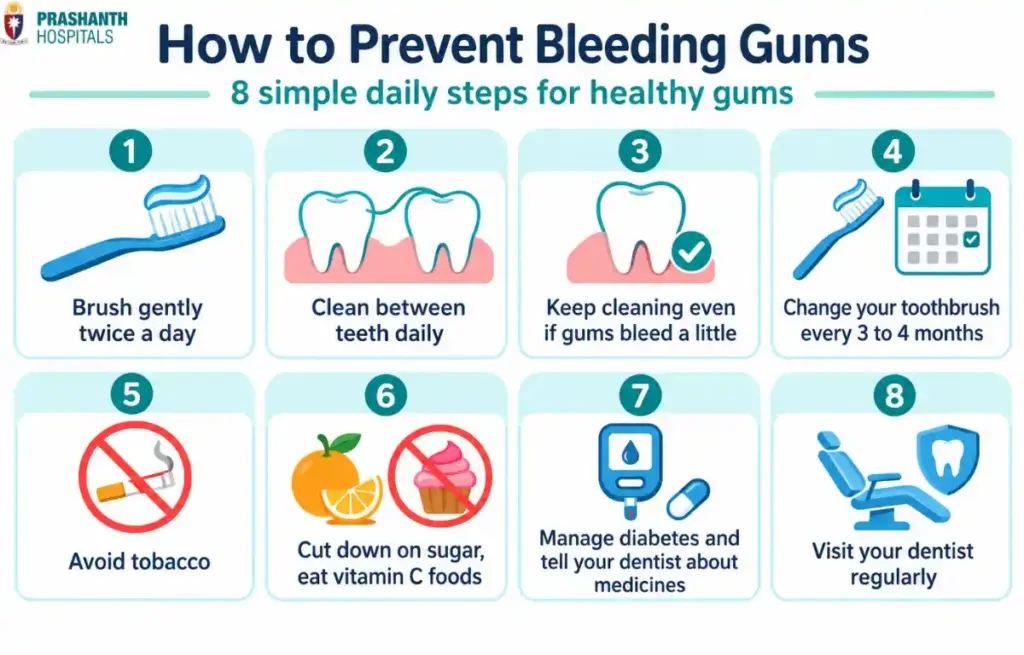
How to Prevent Bleeding Gums: 8 Steps that Help
Preventing bleeding gums does not require an elaborate routine. It requires consistent plaque control without damaging the gum tissue in the process.
1. Brush gently with a soft bristled toothbrush
The idea that harder brushing produces cleaner teeth can actually work against gum health. The American Dental Association recommends brushing twice a day for two minutes with a soft bristled toothbrush and fluoride toothpaste. Both manual and powered toothbrushes can be effective.
Use gentle pressure. Let the bristles do the cleaning instead of scrubbing forcefully across the gumline. Angling the brush slightly toward the gumline, rather than straight on, helps the bristles clean along this area without scrubbing the tissue. Plaque tends to collect where the teeth and gums meet, so this area needs deliberate but gentle cleaning.
2. Clean between your teeth every day
A toothbrush cannot effectively reach every surface between tightly positioned teeth. Floss, interdental brushes, and water flossers can help clean these areas, with the most appropriate option depending on the spaces between your teeth and your individual dental needs.
This is particularly important because plaque left between teeth can irritate the surrounding gum tissue even when the visible tooth surfaces look clean.
The best interdental method is the one you can use correctly and consistently. Someone with tight spaces may benefit from floss, while interdental brushes may be more suitable where spaces are wider or in certain periodontal conditions.
3. Don’t stop cleaning because you see a little blood
If your gums are inflamed, cleaning them may initially reveal bleeding, even when performed correctly and gently. Stopping all interdental cleaning because of that bleeding can allow plaque to remain.
However, this does not mean persistent bleeding should simply be ignored. If bleeding continues for more than a couple of weeks, becomes heavier, or occurs alongside swelling, pain, recession, or other changes, a dental examination is appropriate.
4. Replace your toothbrush every three to four months
Frayed or flattened bristles are less effective at cleaning properly. The ADA generally advises replacing a toothbrush every three to four months, or sooner when the bristles become visibly worn.
5. Avoid tobacco
Smoking and tobacco use can make gum disease more difficult to control. Smoking affects the body’s ability to fight infection and can interfere with gum healing. Avoiding tobacco is therefore an important part of protecting periodontal health.
6. Cut down on sugar and eat a balanced diet
Frequently consuming foods and drinks high in added sugar can contribute to oral disease, while a balanced diet, including adequate vitamin C, supports general and oral health.
7. Manage diabetes and tell your dentist about your medicines
Diabetes and gum health affect each other in both directions. Gum disease may be more severe and slower to heal in people with diabetes, and in turn, unmanaged gum disease can make blood sugar harder to control. This is one of the reasons regular dental care and good blood sugar management work together, rather than being two separate concerns.
A dentist should also know about relevant medications, such as blood thinners, and medical conditions when recurrent gum bleeding cannot be explained by oral hygiene alone.
8. Get regular dental check ups and professional cleaning
Regular dental visits are important even when there is no obvious pain, because gum disease can sometimes develop without dramatic symptoms. Health authorities generally recommend at least one dental check up a year for most adults, though the right frequency for you depends on your oral health, periodontal risk, and your dentist’s recommendation, and may be more frequent if you are pregnant, have diabetes, or have a history of gum disease.
Match the fix to the cause
It is tempting to respond to bleeding gums by buying a different toothpaste, mouthwash, or toothbrush. Sometimes a change in technique is important, but products cannot replace identifying the underlying problem. Certain therapeutic mouthwashes can be a useful short term addition during a flare up of gum inflammation, but these work best alongside good brushing and interdental cleaning, under your dentist’s guidance, rather than as a substitute for them.
| If this is happening… | A sensible next step |
|---|---|
| You brush with considerable force | Switch to gentler pressure and a soft bristled brush |
| You rarely clean between your teeth | Introduce daily interdental cleaning gradually and correctly |
| You can see hardened deposits on your teeth | Arrange professional dental cleaning |
| Bleeding started after improving your oral hygiene | Continue careful, consistent cleaning while monitoring the pattern, and see a dentist if it does not settle within a couple of weeks |
The aim is not to make the blood disappear temporarily. The aim is to remove the reason your gums are bleeding.
How to Stop Bleeding Gums Right Now
If your gums are bleeding after brushing or flossing, these simple steps can help in the moment:
- Rinse your mouth. Rinse gently with cool water, or with warm salt water (about half a teaspoon of salt in a glass of warm water).
- Apply gentle pressure. Press a clean, damp piece of gauze against the bleeding area for a few minutes.
- Use a cold compress for swelling. Hold a cold pack wrapped in a cloth against the outside of your cheek for a few minutes.
- Avoid irritants for the day. Hard, sharp or very spicy foods, and smoking, can irritate inflamed gums further.
- Don’t use strong rinses without advice. Undiluted hydrogen peroxide or harsh mouthwashes can irritate the gum tissue.
These steps can ease bleeding for now, but they do not treat the cause. If bleeding does not stop after 10 to 15 minutes of gentle pressure, or seems heavy, seek prompt medical or dental care, especially if you take blood thinning medicines.
Bleeding Gums During Pregnancy
Hormonal changes can alter the way gums respond to plaque. Pregnancy gingivitis can make gum tissue more prone to inflammation and bleeding, even when a person’s usual oral care routine has not changed, and it generally improves after delivery with continued good oral hygiene.
Gentle brushing, daily cleaning between the teeth and dental check ups remain important during pregnancy. Let your dentist know you are pregnant so care can be planned accordingly.
When Should You See a Dentist for Bleeding Gums?
Not every episode of bleeding means advanced gum disease. But certain signs make professional assessment more important.
| What you notice | What to do |
|---|---|
| Occasional bleeding after inconsistent cleaning | Improve brushing and interdental cleaning, and watch the pattern |
| Bleeding regularly during brushing or flossing | Book a routine dental check up |
| Red, swollen, or tender gums | Book a routine dental check up |
| Visible tartar around the teeth | Book a professional cleaning |
| Persistent bad breath or a bad taste | Book a routine dental check up |
| Bleeding that continues despite careful oral care | Have the cause assessed by a dentist |
| Bleeding that seems heavier or more spontaneous than expected | Speak to your dentist soon, particularly if you take blood thinning medication |
| Gums pulling away from teeth, or pain when chewing | Arrange a prompt dental assessment |
| Loose or increasingly sensitive teeth | Arrange a prompt dental assessment |
| Pus around the gums, very sore or badly swollen gums | Get an urgent dental appointment |
| Ulcers, red patches or a lump in the mouth or on the lip | Get an urgent dental appointment |
The NHS advises seeing a dentist, as routine but not emergency care, if your gums bleed when you brush your teeth or eat hard foods, or if your gums are painful and swollen or you have persistent bad breath. It advises getting an urgent dental appointment if you also have very sore or significantly swollen gums, teeth becoming loose, ulcers or red patches in the mouth, or a lump in the mouth or on the lip.
What a Dental Examination Adds
Home care is essential, but it has limits. You can remove soft plaque yourself; you cannot determine the depth of periodontal pockets or remove hardened deposits hidden below the gumline.
During an assessment, a dental professional may look at:
- The condition of the gum tissue, including redness, swelling, tenderness, and recession.
- Plaque and tartar accumulation, particularly in areas that are difficult to clean.
- The space between the gums and teeth. Deeper periodontal pockets can indicate more advanced gum disease.
- The condition of the teeth and dental restorations. Local factors can sometimes contribute to irritation or difficulty cleaning.
- Your wider risk profile, including smoking, diabetes, medications, and other relevant health factors.
When tartar or established gum disease is present, treatment may involve professional cleaning. When periodontal disease is confirmed, a deeper periodontal cleaning such as scaling and root planing may be recommended, rather than this being a routine step for everyone with occasional bleeding. More advanced disease may require additional periodontal treatment.
The important distinction is simple: prevention happens every day at home, while professional care helps identify and address problems that home care cannot fully manage.
A Daily Gum Care Routine that is Easy to Keep
A routine does not need to be complicated to be effective.
| Part of the day | What to focus on |
|---|---|
| Morning | Brush thoroughly for two minutes with fluoride toothpaste |
| During the day | Limit frequent added sugar exposure, which supports oral health generally |
| Evening | Brush again and clean between the teeth |
| Regularly | Attend dental check ups and professional cleanings when recommended |
| Always | Avoid tobacco and pay attention to changes in your gums |
Gum Care at Prashanth Hospitals
Healthy gums are usually something you do not think about. They allow you to brush, eat, and smile without repeatedly noticing tenderness or blood.
So if bleeding appears once after an unusually vigorous brushing, it may not mean something serious. But if it keeps returning, especially despite careful brushing and interdental cleaning, it is worth finding out why.
At Prashanth Hospitals, the Dental and Oral Surgery department can assess persistent gum bleeding, inflammation, and other changes in oral health. The focus is on identifying the underlying cause and deciding whether improved home care, professional cleaning, or further periodontal treatment is appropriate.
The dental team at Prashanth Hospitals includes:
- Dr. Monica K, Oral Pathology, whose work includes scaling, aesthetic dental care and diagnosis of oral lesions.
- Dr. Arun Murugaiyan, Oral and Maxillofacial Surgery, including dental implants and oral surgery.
- Dr. Srinivas Sivashankaran, Orthodontics.
A Reassuring Perspective
Preventing bleeding gums is less about finding one special product and more about getting the fundamentals right: gentle, thorough brushing, daily cleaning between the teeth, avoiding tobacco, managing relevant health risks, and seeking professional care when the problem does not settle.
The earlier gum inflammation is recognised, the more opportunity there is to address it before it becomes a more complicated periodontal problem.
Healthy gums are built quietly, through small, consistent habits that you keep long after the bleeding has stopped.