A little blood after passing stool can be easy to dismiss. A painful lump may be something you hope will settle on its own. And because piles can be an uncomfortable subject to bring up, many people simply wait until the symptoms get too hard to ignore.
But bleeding, pain, itching or swelling that keeps coming back should not turn into something you just live with.
Piles, also called haemorrhoids, are common and treatable. The key is understanding what is causing the symptoms and matching the treatment to how serious the condition actually is.
If you are looking for piles treatment in Chennai, the first step is not deciding whether you need surgery. It is understanding what is going on.
What are Piles, Really?
Everyone has small cushions of tissue around the lower rectum and anus, made up of blood vessels, muscle and connective tissue working together. Normally, you never notice them because they quietly help you control bowel movements. Piles happen when these cushions get swollen, stretched or pushed out of place, usually from repeated straining or pressure over time.
They can form inside the lower rectum or under the skin around the anus.
| Type | Location | Common symptoms |
| Internal piles | Inside the rectum | Bright red bleeding, tissue coming out; usually painless early on |
| External piles | Under the skin around the anus | Swelling, tenderness, pain or a lump |
Symptoms can be mild at first and may come and go. In some people, though, repeated straining slowly makes the piles more noticeable and harder to ignore.
Doctors often describe internal piles by grade, from Grade I (no visible bulging) to Grade IV (tissue that stays outside the anus and cannot be pushed back in). This grading matters because it directly shapes what treatment is appropriate, from simple lifestyle changes for lower grades to surgery for advanced ones.
That slow build up is exactly why catching things early makes treatment simpler.
Symptoms People Often Brush Off
Piles do not always hurt. Often the first sign is just a small amount of bright red blood after using the toilet.
Other symptoms to watch for include:
Bleeding during or after passing stool. Blood may show up on toilet paper, on the stool itself or in the toilet bowl. Internal piles can bleed without causing much pain at all.
A lump around the anus. External piles can feel like a tender swelling, while internal piles may push out through the anus during a bowel movement.
Itching and irritation. Swollen tissue and mucus can make the area constantly uncomfortable.
Pain or tenderness. This shows up more with external piles, especially if a blood clot forms inside one, known as a thrombosed external pile. This tends to cause sudden, sharp pain rather than the milder discomfort of ordinary piles, and it often needs prompt medical evaluation rather than routine home care, since removing the clot early can bring much faster relief.
Tissue coming out during bowel movements. Internal piles can gradually push through the anus, especially with repeated straining.
One thing worth remembering: not every case of rectal bleeding is piles. Anal fissures, fistulas, infections and other bowel conditions can look similar. If bleeding keeps happening or you are not sure what is causing it, get it checked rather than assuming it is piles and treating it yourself. This matters even more for older adults or anyone with a family history of bowel cancer or other risk factors, where persistent or unexplained bleeding may call for a closer look, such as a colonoscopy.
Why Piles Develop in the First Place
Piles rarely show up after one tough trip to the bathroom. They usually build up slowly, from repeated pressure and irritation around the anus.
A few everyday habits tend to be behind it:
- Constipation and straining put extra pressure on the tissue around the rectum every time you push.
- Spending too long on the toilet, especially while straining, adds pressure in the area over and over.
- Low fibre in your diet leads to harder stools, which means more straining, which means more irritation. It becomes a cycle.
- Pregnancy increases pressure in the abdomen and changes hormones in ways that make piles more likely.
- Irregular bowel habits, whether that means frequent constipation or diarrhoea, keep the area irritated.
- Heavy lifting or activities that repeatedly strain your abdomen can aggravate piles in people who are already prone to them.
This is also why treating the swelling alone is not enough. If constipation or straining keeps happening, the same problem tends to come back even after symptoms improve.
Treatment Depends on How Serious the Piles are
Here is the reassuring part: piles do not automatically mean surgery.
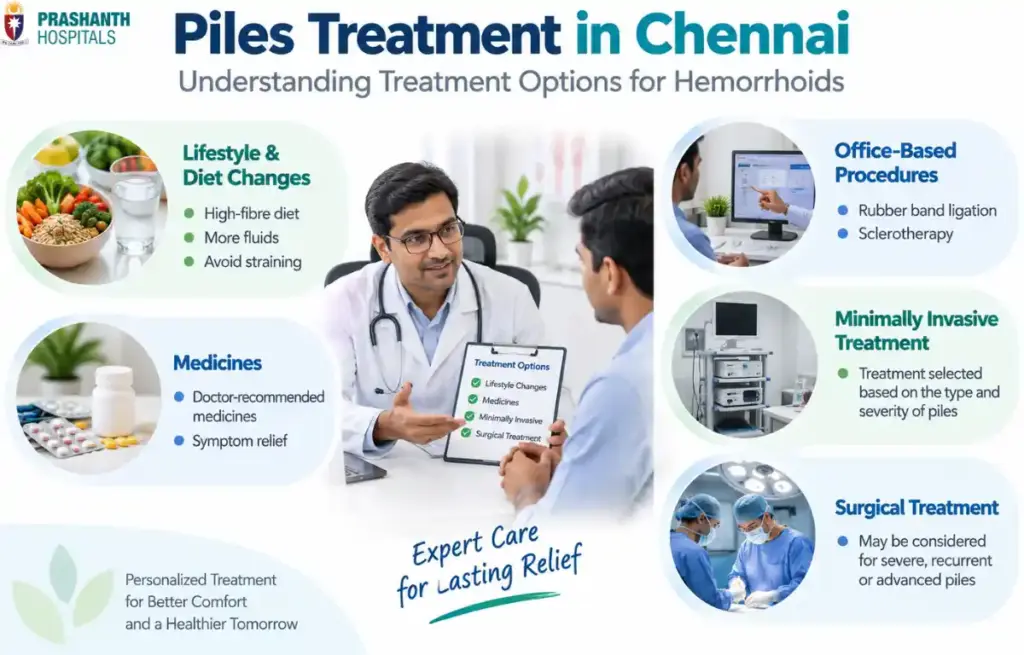
For mild symptoms, the first goal is usually to ease pressure and make bowel movements easier. That can involve:
- Adding more fibre to your diet gradually, so stools become softer and easier to pass. A general target is around 25 to 30 grams a day, though the right amount varies from person to person.
- Drinking enough water, which matters most when you are increasing fibre or prone to constipation. Water alone will not treat piles, but it helps fibre do its job properly.
- Changing toilet habits, like not sitting too long or straining hard.
- Staying active, since movement helps keep your bowels regular.
- Using medicine when it helps, such as something a doctor prescribes for pain, itching, swelling or constipation.
For many people, these steps are enough. But if symptoms keep coming back or get worse, a more targeted treatment may be the next step.
When Medicine alone is Not Enough
If piles do not settle with the steps above, it does not automatically mean major surgery is next. For certain internal piles, simple procedures done at the clinic can do the job.
Rubber band ligation. A small band is placed around the swollen tissue inside the rectum. This cuts off its blood supply, so the tissue gradually shrinks and separates, usually leaving a small scar behind. It works well for suitable internal piles, particularly when bleeding or tissue coming out continues despite home care.
Injection treatment. Sometimes called sclerotherapy, this involves injecting a solution into the swollen tissue to shrink it. It is generally used for lower grade internal piles, and bleeding does not have to be the main symptom for it to be considered.
Laser treatment. Laser haemorrhoidoplasty uses a thin laser fibre to precisely seal off the blood supply to the swollen tissue from the inside, causing it to shrink with minimal damage to the surrounding area. Compared to traditional surgery, it can mean less pain and a faster return to normal activity for suitable patients. It is not automatically the right choice for everyone. Which technique fits best depends on the grade of the piles and what the doctor finds on examination.
Stapled procedures. For certain cases, particularly where several piles are prolapsing together, a stapling procedure can reposition and secure the tissue back in place.
There is no single best treatment that works for everyone. What works depends entirely on what the doctor finds during an examination, including the grade and location of the piles.
When Surgery Makes More Sense
The word surgery tends to worry people more than it should. In reality, it is simply one option along the treatment path, used when other approaches are not enough.
Surgery may be recommended when piles are:
Regularly pushing out through the anus. Tissue that comes out but can still be pushed back in by hand is generally Grade III, while tissue that stays out and cannot be pushed back is Grade IV. Grade IV piles usually need surgery.
Large or advanced enough that clinic based treatments are unlikely to work well.
Coming back repeatedly despite appropriate treatment already being tried.
Not responding to conservative or clinic based treatment, with symptoms significant enough to affect daily life.
The right procedure depends on the grade of the piles, your specific situation, what has already been tried, and your overall health. Severe symptoms alone do not automatically mean surgery is needed. It is the combination of grade, response to earlier treatment and examination findings that guides the decision.
Piles, Fissures and Fistulas are Not the Same Thing
Pain or bleeding around the anus can come from a few different conditions, and they should not be treated as interchangeable.
| Condition | Common pattern |
| Piles | Bleeding, swelling, itching or tissue coming out |
| Anal fissure | Sharp pain during or after bowel movements, sometimes with bleeding |
| Anal fistula | A small tunnel forms near the anus, causing repeated swelling and an opening that drains fluid or pus |
These symptoms can overlap, especially early on. Someone who keeps treating what they think is piles might actually be delaying treatment for a fissure, fistula or something else entirely. Getting the diagnosis right is often the most important step toward getting better.
Signs it is Time to Stop Waiting
Not every mild flare up needs urgent attention. But symptoms that keep returning should not just become part of your routine. Get checked if:
- Bleeding keeps coming back, since repeated bleeding deserves a proper look rather than repeated home treatment.
- Pain or swelling becomes significant, especially if it appears suddenly or gets worse quickly.
- A lump keeps pushing out, which can point to more advanced internal piles.
- Symptoms continue despite home care, which may mean a clinic procedure is worth considering.
- You are simply not sure what is causing it, since several conditions can look alike.
If you notice heavy bleeding, dizziness, weakness or symptoms getting rapidly worse, seek medical attention right away. Black or tarry stools are also a red flag, but they usually point to bleeding higher up in the digestive system rather than typical piles bleeding, so they need prompt evaluation on their own.
Choosing Piles Treatment in Chennai
Finding treatment is not just about locating a hospital that performs piles surgery. A good care pathway starts with a proper assessment and a plan that fits your specific condition, not a one size fits all procedure.
Good care should offer accurate diagnosis, especially when bleeding or pain does not have an obvious cause. It should offer a stepwise approach, since mild piles may respond to lifestyle and medical treatment while advanced piles may need a procedure. It should have real surgical expertise available for recurrent or advanced cases. And it should include follow up, since managing constipation and bowel habits stays important even after symptoms clear up.
This combination of accurate diagnosis, a stepwise approach and surgical backup when needed is generally what people have in mind when they search for the best hospital for piles treatment in Chennai. These are qualities worth checking for at any hospital you are considering, rather than something any single provider can claim without evidence.
Piles Treatment at Prashanth Hospitals in Chennai
If you are looking for piles treatment in Chennai, Prashanth Hospitals offers haemorrhoid care through its General Surgery department and related colorectal services.
The General Surgery team handles piles, fissure and fistula treatment alongside broader colorectal surgical care. The gastroenterology department may also be involved in evaluating patients who come in with rectal bleeding or related bowel symptoms.
Laser treatment for piles is available through the hospital’s Laser Clinic, along with other treatment approaches described above. Laser is not automatically the better or safer option for every patient. Whether it is suitable depends on the grade of the piles and what the doctor finds on examination. If you are specifically researching piles laser treatment cost in Chennai, keep in mind that pricing depends on several things, including how advanced the piles are, which procedure fits your case, and which hospital branch you visit. Rather than going by a number you saw online, it is worth getting a proper estimate during a consultation once a doctor has actually examined you.
Prashanth Hospitals has locations across Chennai, including Velachery, Kolathur, Chetpet, Tambaram and Ambattur. It is a good idea to confirm the right department and doctor availability before visiting.
Relief Should Not Mean Living With the Problem
Piles can be awkward to talk about, but there is no good reason to let recurring bleeding, pain or swelling become something you just put up with.
Most importantly, having piles does not automatically mean you need surgery. Some people improve with better bowel habits and medical treatment. Others benefit from a simple clinic procedure. And some, particularly with advanced or recurring piles, do need surgery.
What matters is figuring out what is actually causing the symptoms and how far along the condition is. Once that is clear, the right treatment becomes much easier to decide on.
If piles keep coming back, the answer is not to keep pushing through the discomfort. A proper evaluation can find the cause, point you toward the right treatment and get you on the path to lasting relief.