Many women don’t think about fertility until they start planning a pregnancy. It usually begins with small doubts. Your cycle becomes irregular. You feel something is “off.” Or you’ve been trying for months without success.
These situations can feel frustrating and emotionally draining. But you don’t have to keep guessing. A fertility test for women helps you understand what’s really happening inside your body. It gives clarity, direction, and most importantly, reassurance that you’re taking the right step forward.
What is a Fertility Test for Women?
A fertility test for women is not just one test. It’s a set of simple checks that look at how your reproductive system is functioning. Instead of jumping to conclusions, these tests help identify where the issue might be—whether it’s related to hormones, ovulation, or structural health. For example, if someone has regular periods but is still unable to conceive, the problem may not be obvious. Testing helps uncover hidden factors that are otherwise easy to miss.
Why Fertility Testing is Important
One of the biggest advantages of fertility testing is early clarity. Many women delay testing, hoping things will improve naturally. While that can happen, waiting too long can also delay the right treatment. When you understand the root cause early, you can make better decisions. It also reduces stress. Instead of worrying every month, you have a clear plan. In many cases, small treatments or lifestyle changes are enough once the issue is identified.
Symptoms of Female Infertility
Fertility issues don’t always show obvious signs, but your body often gives subtle signals that something may need attention. Recognizing these early can help you seek timely evaluation and improve your chances of treatment success.
Common Signs to Watch For
- Irregular Menstrual Cycles: Periods that come too early, too late, or vary significantly each month may indicate ovulation problems.
- Missed Periods (Amenorrhea): Absence of periods for several months can signal hormonal imbalance or ovarian issues.
- Heavy or Very Light Bleeding: Unusually heavy flow or extremely light periods may point to underlying reproductive concerns.
- Severe Menstrual Pain: Intense cramps or pelvic pain during periods could be linked to conditions like endometriosis or fibroids.
- Hormonal Changes
- Persistent acne
- Excess facial or body hair (hirsutism)
- Sudden weight gain or difficulty losing weight
These may indicate conditions like Polycystic Ovary Syndrome.
- Pain During Intercourse: Discomfort or pain during sex can be associated with pelvic conditions affecting fertility.
- Unexplained Pelvic Discomfort: Chronic pelvic pain or pressure may suggest reproductive system issues.
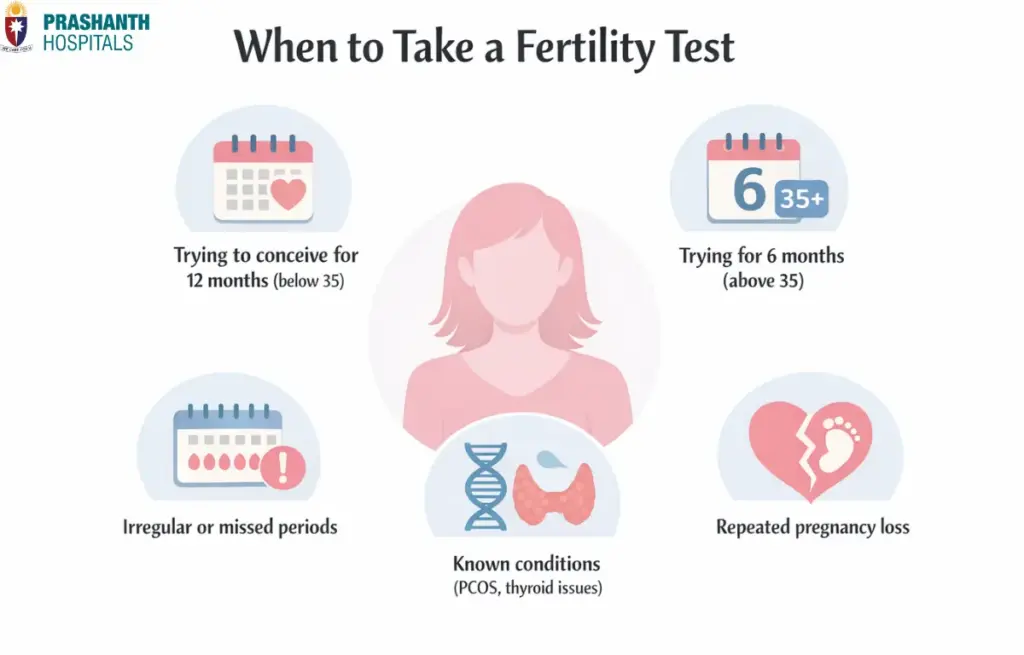
- Difficulty Conceiving: Being married and trying to conceive for 4 to 5 years without success is a strong indication that a fertility evaluation may be needed. Early assessment can help identify underlying causes and guide the right treatment.
- History of Reproductive Conditions: Conditions like Endometriosis, ovarian cysts, or pelvic infections can impact fertility.
- Previous Pregnancy Loss: Repeated miscarriages may indicate underlying fertility or hormonal issues.
Many couples tend to wait longer than needed before seeking help. If you’ve been trying to conceive for a prolonged period without success, it’s a good idea to consider a fertility test. There are also situations where testing earlier makes sense. If your menstrual cycles are irregular, or if you already have conditions like Polycystic Ovary Syndrome or thyroid disorders, getting evaluated sooner can help avoid delays in diagnosis and treatment.
Think of it this way—fertility testing isn’t about rushing into treatment. It’s about understanding your current fertility status and identifying any underlying issues early, so the right steps can be taken with clarity and confidence.
Types of Fertility Tests for Women
Fertility testing is not just one test. It is a combination of checks that look at ovulation, egg quality, uterus health, and fallopian tubes. Each test answers a specific question—together, they give a complete picture of your fertility.
Here are the most important types of fertility tests for women, explained clearly:
Hormone Blood Tests (Basic Fertility Check)
This is usually the first step in any fertility test for women. These tests measure key hormones that control your menstrual cycle and ovulation. It is also commonly referred to as a blood test for women’s fertility in clinical settings.
Doctors typically check:
- FSH (egg development)
- LH (triggers ovulation)
- Estrogen & Progesterone
- Thyroid and Prolactin levels
If these hormones are not balanced, ovulation may not happen properly, which directly affects pregnancy chances. In simple terms: This test tells if your body is “giving the right signals” for pregnancy.
AMH Test (Ovarian Reserve Test)
The AMH test checks how many eggs are left in your ovaries. It is one of the most important tests today.
- Higher AMH → better egg reserve
- Lower AMH → reduced egg count
This test does not check egg quality, but it helps understand your fertility window and planning timeline. This test is often included as part of a blood test for women’s fertility to assess reproductive potential. Think of it as checking your “egg count potential.”
Ultrasound Scan (Pelvic / Transvaginal Scan)
This scan gives a real-time image of your reproductive organs. It helps doctors see:
- Ovaries (egg follicles)
- Uterus shape and lining
- Cysts, fibroids, or abnormalities
It is also used to track ovulation during your cycle. This is like a visual check of your reproductive system.
Ovulation Tracking Tests
These tests confirm whether your body is releasing eggs every month.
It can be done through:
- Blood progesterone test
- Ultrasound monitoring
- Ovulation predictor kits
Even if cycles look regular, ovulation may not always happen properly. These tests confirm it clearly. No ovulation = no chance of pregnancy, so this step is crucial.
HSG Test (Fallopian Tube Test)
HSG (Hysterosalpingography) checks whether your fallopian tubes are open.
- A special dye is passed through the uterus
- X-ray images show if tubes are blocked
Even with normal ovulation and hormones, blocked tubes can prevent pregnancy completely. This test answers a key question: Can egg and sperm actually meet?
Sonohysterography (Uterus Evaluation Test)
This is a specialized ultrasound using saline fluid to get a clearer view of the uterus.
It helps detect:
- Polyps
- Fibroids
- Uterine shape problems
These issues can affect implantation even if fertilization happens.
Hysteroscopy
This is a minor procedure where a small camera is inserted into the uterus.
It helps directly see and sometimes treat:
- Uterine abnormalities
- Polyps or fibroids
It is usually advised if scans show something unclear.
Laparoscopy
This is a minimally invasive procedure used when deeper evaluation is needed.
Doctors use it to diagnose conditions like:
- Endometriosis
- Pelvic adhesions
- Hidden tubal problems
It is not a first-line test, but it is very useful when other tests don’t give clear answers.
Ovarian Reserve Scan (AFC – Antral Follicle Count)
This is done through ultrasound to count small follicles in the ovaries.
- Higher count → better fertility potential
- Lower count → reduced reserve
It is often combined with AMH for better accuracy.
Final Clarity (What All These Tests Do Together)
Each test looks at one part of the fertility process:
- Hormones → Are signals working?
- Ovaries → Are eggs available?
- Ovulation → Is egg release happening?
- Tubes → Is there a pathway?
- Uterus → Is implantation possible?
When combined, these tests remove guesswork and give a clear direction for treatment.
If you’ve been trying to conceive or have cycle-related concerns, it’s worth discussing with a doctor. A structured fertility evaluation can save time and help you move forward with confidence.
How Do Fertility Tests Work?
The process usually starts with a consultation where your doctor understands your medical history and symptoms. Based on this, specific tests are recommended. These tests are often timed with your menstrual cycle for accurate results. For example, hormone levels are checked early in the cycle, while ovulation tracking happens later.
Most tests are simple and do not require hospital admission. Once results are ready, your doctor will explain what they mean and guide you on the next steps. Many women find the process easier than they expected.
Can You Do a Fertility Test at Home?
Home fertility kits have become popular because they are easy to use and accessible. They can help track ovulation and identify fertile days, which is useful for timing pregnancy.
However, they only provide limited information. They cannot assess internal health, hormone balance in detail, or structural conditions. This is why they are best used as a starting point rather than a complete solution. If results are unclear or if you continue facing difficulties, a clinical fertility test for women offers a more reliable and complete evaluation.
Cost of Fertility Test for Women
The fertility test for women cost can vary depending on the type of tests and clinic. Basic tests are more affordable, while advanced procedures may cost more. Many centers offer packages that combine tests, which can reduce the overall fertility test for women price and make evaluation more convenient.
Causes of Female Infertility
Female infertility can result from a range of factors, and often it’s not just one single cause. Hormonal imbalances are common and can affect ovulation. Conditions like PCOS can make cycles irregular, while endometriosis can cause internal inflammation that affects fertility.
Age is another important factor. As women grow older, egg quality and quantity gradually decline. Lifestyle habits such as poor diet, stress, and lack of sleep can also play a role over time.
Understanding the cause is key. Once identified, many of these conditions can be managed with the right approach.
How to Improve Fertility Naturally
While medical support is important, everyday habits also play a big role in fertility. A balanced diet with proper nutrients supports hormone function. Maintaining a healthy weight helps regulate cycles.
Stress management is often overlooked, but it can impact hormonal balance. Simple steps like regular sleep, light exercise, and tracking your cycle can make a noticeable difference. These changes may seem small, but over time they create a healthier environment for conception.
When to See a Fertility Specialist
There comes a point where expert guidance becomes important. If you’ve been trying without success, or if you notice ongoing cycle issues, it’s best not to delay. A fertility specialist can guide you with the right tests and treatment plan based on your specific condition. This avoids trial-and-error approaches and gives you a clear direction.
If you have concerns about your fertility, consider consulting a qualified doctor. Getting clarity early can make the entire journey smoother and less stressful.
Conclusion
Fertility concerns can feel overwhelming, but they don’t have to remain uncertain. With the right information and timely evaluation, most issues can be clearly understood and managed. A fertility test for women is the first step toward clarity, it helps you move from doubt to a structured plan.
If something doesn’t feel right or if you’ve been trying without success, it’s important to speak with a specialist early. At Prashanth Hospitals, patients are supported with a step-by-step approach, from evaluation to treatment planning, ensuring clarity, comfort, and confidence at every stage. Early guidance can make a meaningful difference in your journey toward parenthood.