Deciding to start IVF treatment in Chennai can feel overwhelming. Couples often have questions, worries and doubts about what lies ahead. This is completely natural. Many couples, women and families in India feel the same when they first look into in vitro fertilisation (IVF).
At Prashanth Hospitals in Chennai, the aim is simple: to help couples understand their options clearly and support them through each step. This guide explains IVF in plain words, the way a doctor would in a calm conversation. It focuses on what matters most to patients: clarity, reassurance and practical insight.
Why Choose Prashanth Hospitals for IVF in Chennai?
Choosing where to have fertility care is an important decision. IVF treatment in Chennai, like anywhere else, involves planning, close monitoring, teamwork and personal attention. Here is how Prashanth Hospitals approaches fertility care.
Experienced Fertility Team
Couples at Prashanth Hospitals are cared for by fertility specialists, gynaecologists and embryologists who work together on each case. Clinical experience helps guide decisions on timing, testing and care suited to each couple.
Support Beyond Procedures
IVF is more than a medical procedure. It brings emotional ups and downs, lifestyle changes and decisions that affect daily life. At Prashanth Hospitals, fertility counsellors and nurses support couples along with the doctors.
Personalised Care Plans
No two fertility journeys are the same. The care team takes time to understand each couple’s history, test results and preferences. This helps shape a plan that suits the person’s body and life.
Comfortable Environment for Families
The hospitals are designed with privacy, clear communication and courteous staff in mind. A calm setting helps reduce stress during treatment.
Understanding IVF Treatment
IVF stands for in vitro fertilisation. But what does that really mean for the body?
IVF is a guided process where eggs and sperm are joined outside the body in a lab. Once an embryo forms, it is placed in the uterus so a pregnancy can begin.
Here is the process in simple steps:
1. Preparation and Evaluation
Before IVF begins, the doctor reviews the woman’s health and fertility history. This often includes:
- Blood tests
- Ultrasound scans
- Hormone level checks
These tests show how the ovaries are working and whether any other condition might affect treatment.
2. Stimulating the Ovaries
Small doses of medicine help the ovaries grow several follicles (tiny sacs that hold eggs). Some women feel mild discomfort, similar to bloating. The doctor monitors progress closely through scans and blood tests.
3. Egg Retrieval
When the follicles are ready, eggs are collected through a minor procedure under light sedation. Sedation keeps the woman comfortable during the procedure, and most women return to normal activities within a day.
4. Fertilisation and Culture
In the lab, healthy sperm are selected and joined with each egg. The embryologist then watches the embryos grow over several days. This step needs precision, but it is a routine part of fertility care.
5. Embryo Transfer
Once embryos develop, one or more are placed in the uterus. This takes only a short time, and some women feel mild cramping. Most women go home to rest the same day. Transferring more than one embryo raises the chance of twins, so the doctor discusses how many embryos to transfer.
6. Pregnancy Test and Follow‑Up
About two weeks after embryo transfer, a blood test shows whether pregnancy has begun. If the result is positive, follow up care continues until the pregnancy is stable.
At every step of IVF treatment in Chennai at Prashanth Hospitals, the care team explains what is happening and answers questions at each visit.
When IVF Does Not Work the First Time
Many couples ask what happens if the first IVF cycle does not lead to pregnancy. This is common, and it does not always mean IVF will not work.
When a cycle is not successful, the doctor reviews what happened at each stage. This may include how the ovaries responded to medicine, the number and quality of eggs, how the embryos developed and the condition of the uterus. Based on this review, the doctor may suggest changes such as a different medicine plan, extra tests, genetic testing of embryos or a frozen embryo transfer.
Some couples need more than one cycle. Each cycle also gives the doctor useful information to plan the next one more carefully.
How Age Affects IVF Success
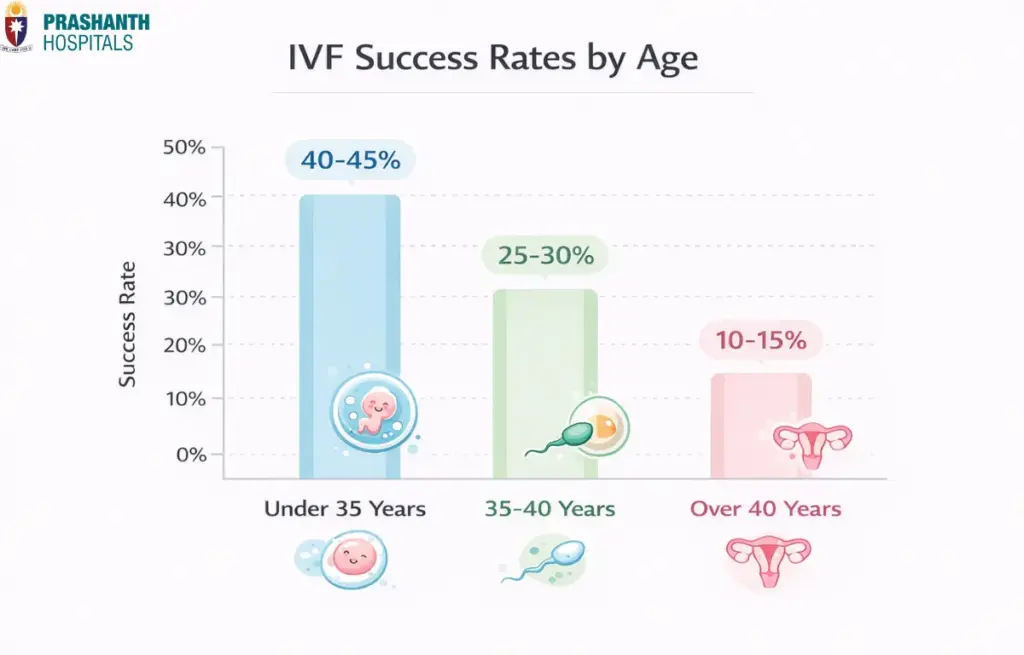
Every couple wants to know one thing above all else: what are the chances? No doctor can promise an outcome, but success does follow a pattern based on age. This is because the number and quality of eggs change over time.
The table below shows general ranges reported in fertility research. They are not results from any single hospital.
| Age Group | General Success Rate per Cycle |
|---|---|
| Under 35 | 50 to 60% |
| 35 to 40 | 35 to 40% |
| Above 40 | 15 to 20% |
These figures can vary based on health, ovarian reserve and other conditions. The doctor gives a more personal picture after evaluation.
At Prashanth Hospitals, doctors explain what these numbers mean for each couple, and which steps may help, such as timing, medicine changes or extra testing.
Who Can Benefit from IVF?
IVF may be suggested for several fertility situations. Here are some common ones.
1. When Natural Conception Is Difficult
Couples who have tried to conceive for over a year without success may consider IVF. After tests, the doctor can advise whether IVF is a sensible next step.
2. Conditions Affecting Fertility
Women with conditions such as polycystic ovary syndrome (PCOS), endometriosis or blocked fallopian tubes may find IVF helpful. IVF works around some of the problems these conditions cause.
3. Male‑Factor Infertility
If sperm count or movement is low, IVF can still be an option. In some cases, a technique called ICSI (intracytoplasmic sperm injection) is used.
4. Age‑Related Fertility Concerns
Fertility naturally declines with age, especially after the mid 30s. IVF can help some women try for pregnancy with their own eggs. In some cases, egg donation may be discussed, and doctors explain this gently and clearly.
5. Single Parents and Same‑Sex Couples
Under India’s Assisted Reproductive Technology (Regulation) Act, 2021, single women can also access IVF. Doctors explain the legal requirements and the options available during consultation.
The doctor at Prashanth Hospitals helps each couple understand whether IVF is suitable, based on tests and a discussion of their goals.
Male Infertility Testing and Treatment
Fertility problems are often seen as a woman’s issue, but that is not the full picture. In nearly 4 out of 10 cases, a male factor plays a role, sometimes along with a female factor and sometimes on its own.
At Prashanth Hospitals, male fertility is checked early so couples are not left guessing.
Tests that may be done:
- Semen Analysis: Looks at sperm count, movement and shape. This is usually the first and simplest test.
- DFI Testing (DNA Fragmentation Index): Checks the quality of DNA inside the sperm. This can affect fertilisation and embryo health even when sperm count looks normal.
- Micro TESE: A precise surgical method to collect sperm directly from the testes, for men with very low or no sperm in their semen.
How it is treated:
Depending on test results, the doctor may suggest lifestyle changes, medicine or ICSI (a method where a single healthy sperm is injected directly into an egg). In more complex cases, Micro TESE combined with IVF may still allow biological parenthood.
The fertility team explains each result in plain language and walks couples through what comes next. you through what comes next.
Fertility Services at Prashanth Hospitals
IIVF is one part of fertility care. Prashanth Hospitals offers a range of services so the plan can match each couple’s needs.
- In Vitro Fertilisation (IVF): Eggs and sperm are joined in a lab before embryo transfer. Each step of IVF treatment in Chennai at Prashanth Hospitals is explained and planned around the couple.
- Intracytoplasmic Sperm Injection (ICSI): Helps when sperm quality is low. A single sperm is carefully injected into an egg.
- Intrauterine Insemination (IUI): In some cases, IUI, a simpler procedure, may be tried before IVF. Prepared sperm is placed directly into the uterus.
- 3D Hysterolaparoscopy: A keyhole procedure to check for and treat problems in the uterus and pelvis that may affect fertility.
- Laser Assisted Hatching (LAH): Gently thins the outer shell of the embryo to help it attach. It may be useful in certain cases.
- Blastocyst Transfer: Embryos are transferred at the blastocyst stage (5 to 6 days old), which may help implantation in some cases.
- Egg and Sperm Freezing (Cryopreservation): An option for future family planning, before medical treatments or for personal timing.
- Sperm and Embryo Cryopreservation: The lab stores sperm and embryos safely for future use, with careful monitoring.
- Donor Programme: For couples who need donor eggs or sperm, as permitted under Indian law, with ethical and supportive guidance.
- Surrogacy Guidance: For couples who meet the conditions of the Surrogacy (Regulation) Act, 2021, doctors explain the legal process and the options available.
- Fertility Counselling: Fertility treatment involves both the body and emotions. Counsellors help couples manage stress, expectations and wellbeing.
Each couple’s care plan includes only the procedures they need, explained in clear, simple terms.
Genetic Testing (PGT-A, PGT-M, PGT-SR)
Sometimes a healthy looking embryo does not lead to pregnancy, or a pregnancy does not continue. Often the reason lies in the embryo’s chromosomes, which cannot be seen under a microscope.
This is where Preimplantation Genetic Testing (PGT) helps. Before an embryo is transferred, a few cells are taken and tested in the lab.
- PGT A: Checks for the correct number of chromosomes. It may help women over 35 or those with past failed cycles.
- PGT M: Looks for a specific inherited condition that runs in the family, when parents are known carriers.
- PGT SR: Checks for changes in chromosome structure, which can affect couples where one partner carries a balanced translocation.
Testing embryos is a personal choice, not a routine step. The team discusses whether PGT suits each situation, what it can and cannot show, and what the next steps would be.
Inside Our IVF Lab and Technology
Much of IVF happens quietly in the lab, away from the consultation room. Patients rarely see this part, but it matters as much as the doctor’s skill.
At Prashanth Hospitals, the embryology lab is set up to keep embryos in a stable, protected environment.
- Closed Working Chamber: Limits the embryo’s exposure to air, light and temperature changes while it is handled.
- Continuous Monitoring: Embryos are observed at each stage of growth without being disturbed.
- AI Assisted Embryo Selection: Gives embryologists extra information when choosing which embryo to transfer, alongside their trained judgement.
This technology does not replace the embryologist. It supports their decisions with more consistent information.
When choosing an IVF hospital in Chennai, it is worth asking what happens in the lab. The team at Prashanth Hospitals explains this openly.
Meet Our Specialists
Couples at Prashanth Hospitals are cared for by a team of fertility specialists and gynaecologists.
- Dr. C. Geetha Haripriya – MD, DGO, FRCOG, FICOG. 40+ years of experience. Chairperson, Prashanth Group of Hospitals.
With more than four decades in fertility care, Dr. C. Geetha Haripriya provides IVF treatment in Chennai along with IUI, ICSI and embryo transfer. Her consultations focus on clear explanations and careful planning. - Dr. S. Sailaja – MBBS, DNB, DRM. 25+ years of experience, Senior Consultant
Dr. Sailaja works in reproductive medicine, including IUI, ICSI and embryo transfer. She explains each procedure, along with the expected IVF treatment cost in Chennai, so families can make informed decisions. - Dr. Usha Todadri – MBBS, DNB. 35+ years of experience, Senior Consultant
Consultant. Dr. Usha Todadri has long experience in obstetrics, maternal and fetal medicine and high risk pregnancy. She supports women through pregnancy after fertility treatment and explains each stage clearly. - Dr. Samhitha Moturi – MBBS, MS, FRM, FMAS. 5+ years of experience, Medical Director – Prashanth Group of Hospitals
Dr. Samhitha Moturi is trained in reproductive medicine and minimal access surgery. She guides couples through IUI, ICSI and embryo transfer and keeps them informed at each step.
Questions to Ask Before Starting IVF
Asking the right questions helps couples feel prepared and confident. Useful questions for the first consultation include:
- What tests are needed for both partners before IVF?
- Is IVF the right first step, or should other treatments be tried first?
- How many visits will the cycle need, and how long will it take?
- What medicines are involved, and what side effects can be expected?
- What is the full cost, including medicines, lab work and embryo freezing?
- What happens to extra embryos?
- What are the next options if the first cycle does not work?
The care team at Prashanth Hospitals is happy to answer these questions before treatment begins.
Preparing for IVF Treatment
Preparation helps couples feel confident and supported. Here is what to focus on.
Health Check and Counselling
Before starting IVF, there is a full evaluation. This includes medical history, a physical examination and tests that help personalise the plan.
Lifestyle Adjustments
Small changes can help the body prepare:
- Eat balanced meals with fruits, vegetables and protein.
- Avoid smoking and limit alcohol.
- Try gentle exercise if the doctor recommends it.
- Focus on good sleep and managing stress.
These steps do not guarantee pregnancy, but they support overall wellbeing during treatment.
Emotional Readiness
Some patients find support groups helpful. Others speak with counsellors to manage expectations and stay grounded. This is a normal and healthy part of the process.
Conclusion – A Thoughtful Step Forward
Starting IVF treatment in Chennai is a personal decision. It can bring hope, questions and new possibilities. At Prashanth Hospitals, the focus is on clear guidance, honest communication and care that respects each couple’s needs and choices.
Anyone considering IVF can talk with a fertility specialist, ask questions and share concerns. Every journey is different, and good care respects that.