
A stroke can happen to anyone, at any age. It can change a person’s life in minutes. Quick action and the right emergency care for stroke can make a real difference in recovery.
This guide explains the signs and symptoms of stroke, why every minute matters, and what happens when someone reaches the hospital in time.
What is a Stroke?
A stroke happens when the blood supply to part of the brain is cut off. Without blood, brain cells do not get the oxygen they need. They begin to die within minutes.
There are two main types of stroke.
- Ischaemic stroke This is the most common type. It happens when a blood clot blocks an artery that carries blood to the brain. About 85 out of every 100 strokes are this type.
- Haemorrhagic stroke This happens when a blood vessel in the brain bursts and bleeds. It is less common, making up about 15 out of every 100 strokes. It needs different treatment than an ischaemic stroke.
Doctors need to find out which type a person has before they can treat it. This is why calling for emergency help right away, instead of waiting to see a doctor later, is so important.
Signs and Symptoms of Stroke: The FAST Test
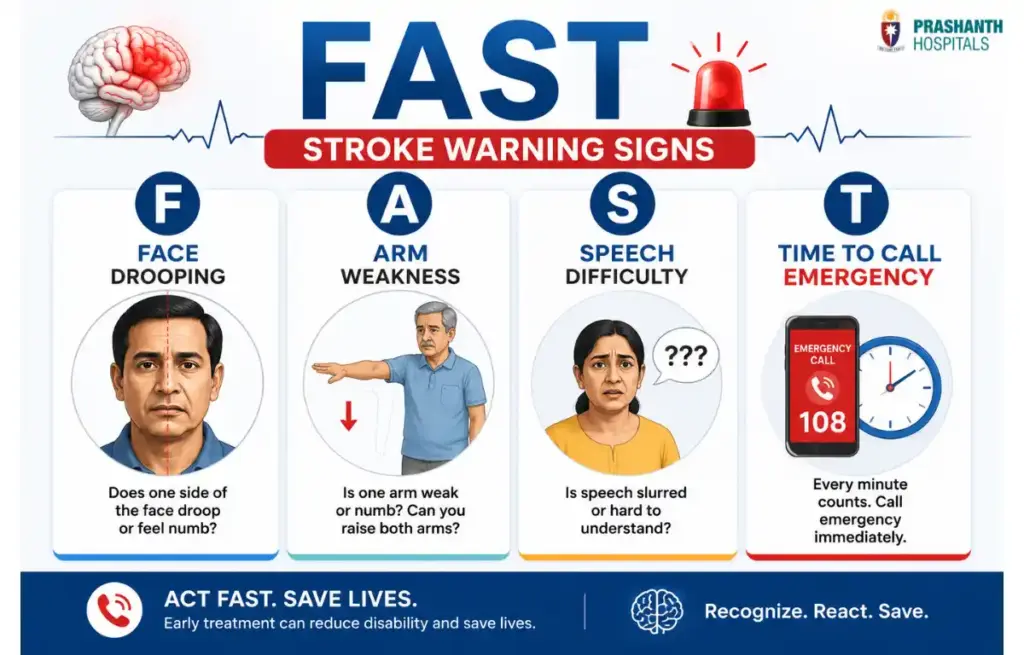
The FAST test is a simple way to check for stroke symptoms in yourself or someone else.
- F is for Face. Ask the person to smile. Does one side of the face droop?
- A is for Arms. Ask the person to raise both arms. Does one arm drift downward?
- S is for Speech. Ask the person to repeat a simple sentence. Is their speech slurred or strange?
- T is for Time. If you see any of these signs, call for emergency help right away.
Some hospitals now use an extended version called BE-FAST. This adds two more signs to check for.
- B is for Balance. Has the person suddenly lost their balance or coordination?
- E is for Eyes. Has the person lost vision in one or both eyes, or are they seeing double?
If you notice any of these signs, do not wait. Call for emergency help straight away, even if the symptoms seem mild.
What to Do While Waiting for Help
What you do in the first few minutes can affect how well someone recovers. Keep these points in mind.
- Call an ambulance. Do not drive the person yourself. Paramedics can assess the patient on the way and alert the hospital’s stroke team before arrival, which often means faster treatment.
- Note the exact time the symptoms started, or the last time the person was seen acting completely normal. This is one of the first questions the stroke team will ask, and it affects which treatments are possible.
- Do not give aspirin or any other medicine. Aspirin helps with a heart attack, but not a stroke. If the cause is bleeding in the brain, aspirin can make it worse. Let the medical team decide.
- Do not give food, drink, or oral medicine. A stroke can affect the muscles used for swallowing, even when this is not obvious, and this raises the risk of choking.
- Stay calm and stay with the person until help arrives, and share everything you noticed with the paramedics.
Other Signs and Symptoms of Stroke to Watch For
Stroke does not always look the same in every person. Along with FAST and BE-FAST, watch for:
- Sudden confusion or trouble understanding others
- Sudden, severe headache with no clear cause, which can point to a haemorrhagic stroke
- Sudden numbness, especially on one side of the body
- Sudden trouble walking or feeling dizzy
Many strokes, especially ischaemic strokes, happen without any headache. The absence of a headache does not rule out a stroke, so treat any sudden sign on this list as an emergency.
What Is a TIA, or Mini-Stroke?
A TIA, short for transient ischaemic attack, is sometimes called a mini-stroke. It causes the same signs as a stroke, but the symptoms go away within a few minutes to a few hours.
A TIA is not something to brush off. It is a warning sign that a full stroke could follow in the next few hours or days. Seek emergency medical assessment immediately, even if the person feels completely normal again. The risk of a full stroke is highest in the first day or two after a TIA, so this is not something to schedule for later.
Who Is at Risk of Stroke?
Some health conditions and habits raise the chances of having a stroke. Knowing your risk factors can help you take steps to protect yourself.
- High blood pressure
- Diabetes
- An irregular heartbeat, known as atrial fibrillation
- High cholesterol
- Smoking
- Being overweight
- A previous stroke or TIA
- Growing older
- A family history of stroke
- Sleep apnoea, a condition where breathing repeatedly stops and starts during sleep
Having one or more of these does not mean a stroke will definitely happen. It means it is worth talking to your doctor about ways to lower your risk.
What Happens During Emergency Care for Stroke?
Knowing what to expect can help calm fears during a stressful time. Here is what usually happens once someone reaches the hospital with stroke symptoms.
Step 1: Quick assessment Doctors will ask exactly when the symptoms started, or the last time the person was seen completely normal, and run quick tests to check movement, speech, and alertness.
Step 2: Brain scan A CT scan or MRI scan helps doctors see what is happening inside the brain. This tells them whether it is an ischaemic stroke or a haemorrhagic stroke.
Step 3: Treatment based on stroke type For an ischaemic stroke, carefully selected eligible patients may receive a clot-busting medicine called thrombolysis, which works best within four and a half hours of the first symptoms. Not everyone who arrives in time qualifies. Doctors check for things like recent surgery, blood thinning medicines, or a high bleeding risk first.
Patients with a large blood vessel blockage confirmed on brain imaging may also benefit from mechanical thrombectomy, a procedure to remove the clot directly. This can sometimes help up to 24 hours after symptoms start, depending on the scan and how much brain tissue can still be saved.
For a haemorrhagic stroke, treatment is different. Clot-busting medicine is not used, since it could make the bleeding worse. Instead, doctors focus on controlling the bleeding and reducing pressure on the brain.
Step 4: Stroke unit care After initial treatment, the person is usually moved to a stroke unit, where a team watches closely for any changes and plans the next steps for recovery.
Stroke Recovery: What Comes After Treatment?
Recovery looks different for everyone. Some people recover fully within weeks. Others need more time and support. The brain has a remarkable ability to adapt and rebuild connections, a process called neuroplasticity, which is why rehabilitation matters so much. Recovery often continues for months, and sometimes years, after a stroke. It does not stop the day someone leaves the hospital.
Common parts of stroke recovery include:
- Physiotherapy, to rebuild strength, balance, and movement
- Speech therapy, to help with talking, understanding, and swallowing
- Occupational therapy, to relearn everyday tasks like dressing or cooking
Recovery often takes patience. Small wins, like holding a cup again or saying a few clear words, are real progress. Family support plays a big role in helping a stroke survivor stay motivated.
How to Lower Your Risk of Stroke
You cannot control every risk factor, but many healthy habits can help protect your brain.
- Control high blood pressure, the single biggest risk factor you can change
- Manage blood sugar levels if you have diabetes
- Get an irregular heartbeat checked and treated
- Avoid smoking, or take steps to quit
- Stay active with regular movement or exercise
- Eat a balanced diet with less salt and saturated fat
- Take any prescribed medicines as your doctor advises
- Go for regular health checks, especially if you have risk factors
Stroke Emergency Care at Prashanth Hospitals
At Prashanth Hospitals, our emergency care team is ready around the clock for stroke patients. Our Neurology and Neurosurgery department works closely with the emergency team to assess and treat stroke quickly, including thrombolysis and thrombectomy when needed. Once a patient is stable, our stroke unit and rehabilitation team support the next steps, from physiotherapy to speech and occupational therapy.
If you or a loved one ever shows signs of stroke, do not wait. Call for emergency help right away rather than driving the person yourself. Every minute matters.