A sudden sharp pain in your breast can stop you in your tracks. One moment you are fine. The next, there is a stabbing or shooting pain that comes out of nowhere. Naturally, your mind goes to the worst-case scenario.
But here is something important to know before you read any further. Sharp breast pain is very common. It affects women of all ages. And in most cases, it has a straightforward, non-serious cause.
This guide explains the most common causes of sharp pain in the breast, including pain in the left or right breast, what the symptoms may feel like, when you can monitor the pain at home, and the warning signs that mean it is time to see a doctor. With the right information, you can better understand your symptoms and seek care when needed.
Is Sharp Breast Pain a Sign of Breast Cancer?
This is the first question most women ask. And it makes complete sense to wonder.
The reassuring answer is that breast pain alone is rarely a sign of breast cancer. Most women who experience sharp, shooting, or stabbing pain in their breast are not dealing with cancer. Breast cancer is more commonly detected because of a painless lump, skin changes, nipple changes, or abnormal imaging than pain alone. Research shows that only a small percentage of women newly diagnosed with breast cancer report breast pain as their main symptom.
That said, there is one exception worth knowing about. Inflammatory breast cancer is a rare but aggressive form of breast cancer that can cause pain. But it almost always comes with other noticeable changes. The breast may become red, swollen, warm to the touch, and noticeably heavier. These changes tend to happen quickly.
Pain on its own, without any changes to the breast skin, shape, or texture, is very unlikely to indicate cancer.
The most important thing is this. If you notice anything that feels new or unusual, get it checked. Not because it is probably serious, but because finding out quickly gives you peace of mind and better options if something does need attention.
Understanding the Types of Breast Pain
Before jumping into causes, it helps to understand the three broad types of breast pain. Knowing which one fits your experience can help your doctor narrow things down faster.
- Cyclical breast pain is tied to your menstrual cycle. It tends to show up in the days before your period and eases once your period starts. It usually affects both breasts and can feel achy, heavy, or sharp.
- Non-cyclical breast pain has no connection to your menstrual cycle. It may come and go randomly. It is often felt in one breast or in a specific spot. This type is more common in women over 35.
- Chest wall pain does not actually start in the breast tissue. It comes from the muscles, ribs, or cartilage around your chest. But it can feel like it is deep inside the breast. This type is often sharp and can be triggered by movement.
Sharp pain in the left breast or right breast that comes and goes is most often either cyclical or chest wall pain. But there are several other causes worth understanding.
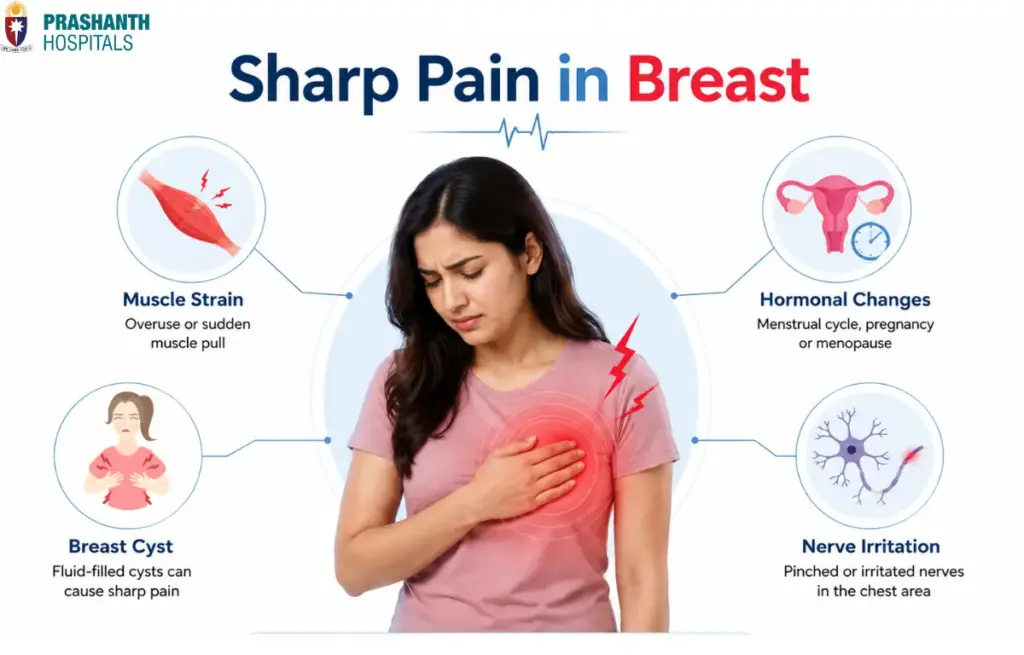
Common Causes of Sharp Pain in the Breast
1. Hormonal Changes
This is the most common cause of breast pain in women. Your hormones, particularly oestrogen and progesterone, fluctuate throughout your menstrual cycle. In the days before your period, these hormones rise. This causes the breast tissue to swell slightly, which can lead to tenderness, achiness, or even sharp, shooting pain.
The pain typically starts around three to five days before your period begins. Once your period starts and hormone levels drop, the pain usually fades. Some women feel it in both breasts. Others notice it more on one side. The pain can sometimes travel into the armpit or upper arm as well.
During pregnancy, especially in the first trimester, many women experience similar breast soreness. This is again due to rising hormone levels as the body adjusts to pregnancy.
If hormonal changes are behind your breast pain, a few simple adjustments can help. Cutting back on caffeine and reducing salt intake may ease symptoms for some women. Wearing a well-fitted, supportive bra makes a real difference too. If the pain is severe or disrupting daily life, speak with your doctor.
2. Muscle Strain or Chest Wall Pain
This cause surprises a lot of women. What feels like a sharp pain coming from inside the breast is sometimes not breast-related at all. It is coming from the muscles, ribs, or cartilage just below the surface.
A condition called costochondritis is a good example. This happens when the cartilage connecting your ribs to your breastbone becomes inflamed. The pain is often sharp and stabbing. It can feel worse when you press on your chest, take a deep breath, cough, sneeze, or stretch. Many women describe it as a sharp pain in the left or right side of the chest that comes and goes.
Muscle strain from heavy lifting, sudden movements, sleeping in an awkward position, or a new exercise routine can also cause this kind of pain. Because the pain sits close to the surface of the breast, it can be very difficult to tell the difference without a proper examination.
A useful way to check. If pressing on the area around your ribs or the side of your chest causes or worsens the pain, it is likely coming from the chest wall rather than the breast tissue itself. During a physical examination, your doctor may press over the rib cartilage to reproduce the pain. This is one of the key ways they confirm chest wall pain and rule out other causes.
3. An Ill-Fitting or Unsupportive Bra
This one is more common than most women realise. Your breasts are held up by ligaments that attach to your chest wall. If your bra does not provide enough support, these ligaments are constantly being stretched. Over time, this strain can cause aching or sharp pain, especially after a long day or during exercise.
The pain may feel like it is pulling or stabbing from inside the breast. It is often worse by the end of the day or after physical activity.
Getting professionally measured and wearing the correct bra size makes a significant difference. This is especially true during high-impact exercise. A good sports bra is one of the simplest ways to prevent breast discomfort.
4. Breast Cysts
Breast cysts are small, fluid-filled sacs that develop inside breast tissue. They are benign, meaning they are not cancerous. They are very common, particularly in women between the ages of 35 and 50.
As a cyst grows, it presses on the surrounding breast tissue. This pressure can create a sudden sharp or shooting pain. Some women notice a smooth, moveable lump along with the pain. The lump may feel more noticeable or painful just before a period and less obvious after.
Most breast cysts do not need any treatment. Your doctor can confirm a cyst with an ultrasound scan. If the cyst is causing significant pain or discomfort, it may be drained using fine-needle aspiration. The procedure is quick and straightforward.
If you feel a lump in your breast, always get it assessed by a doctor, even if it does not hurt. Most lumps are benign, but it is always worth checking.
5. Mastitis or Breast Infection
Mastitis is an inflammation of the breast tissue. It is most common in women who are breastfeeding, but it can happen at other times too.
When mastitis is caused by a bacterial infection, it can produce a sharp, throbbing pain in one breast. The breast may also feel red, warm, and swollen. Some women develop a fever along with the breast pain and may feel generally unwell, similar to having the flu.
An abscess is a related but more advanced condition. It is a pocket of pus that forms just under the skin as a result of infection. Along with pain and swelling, you might notice a lump that feels warm and firm, and possibly some discharge from the nipple.
Both mastitis and breast abscesses need medical treatment. Mastitis is usually treated with antibiotics. An abscess may need to be drained. Breastfeeding mothers are usually encouraged to continue breastfeeding or expressing milk during treatment, unless their doctor advises otherwise. Do not try to manage these at home. If you have sharp breast pain with a fever, redness, or swelling, see a doctor promptly.
6. Breast Injury or Trauma
Your breasts can be injured just like any other part of your body. A knock, fall, sports impact, or even an accidental bump can cause sharp pain. You may feel the pain immediately at the time of injury, and some tenderness can linger for several days or even weeks.
After a breast injury or surgery, a condition called fat necrosis can sometimes develop. This happens when fat cells in the breast are damaged and die. Small lumps may form as a result. These lumps are not cancerous, but they can cause breast pain and need to be properly assessed by a doctor to rule out other causes.
If you have had a recent injury and notice bruising, swelling, or a new lump that does not improve within a couple of weeks, book an appointment to get it checked.
7. Medications
Some medications can cause breast pain as a side effect. Women do not always make this connection, but it is worth considering if your breast pain started around the same time as a new prescription.
Common culprits include:
- Hormonal contraceptives such as birth control pills or injections
- Hormone replacement therapy (HRT), used during or after menopause
- Certain heart medications (such as spironolactone)
- Diuretics, also known as water tablets
- Some psychiatric medications
- Fertility treatments
If you think a medication may be behind your breast pain, do not stop taking it without speaking to your doctor first. There may be an alternative that works better for you.
8. Breast Implant-Related Pain
Women who have had breast augmentation may occasionally experience sharp pain related to their implants. One of the more common causes is capsular contracture. This happens when the scar tissue that naturally forms around a breast implant begins to tighten or harden. The pressure this creates can cause a sharp, shooting pain.
In some cases, breast pain after augmentation may indicate that an implant has shifted or ruptured. It is worth knowing that implant rupture does not always cause pain. It can happen silently and may only be detected through imaging. If you have breast implants and notice any new or worsening pain, always speak with your surgeon. Do not assume it is normal.
Sharp Pain in the Left Breast vs. Right Breast
Many women search specifically for what it means to feel sharp pain in the left breast or sharp pain in the right breast. Here is what you need to know.
In most cases, the side of the pain does not change what is causing it. Whether the pain is on the left or right, hormonal changes, cysts, chest wall strain, or infection can all affect either breast.
However, there is one important exception when it comes to left-sided pain. Sharp pain in the left breast that comes and goes can sometimes originate from the heart rather than the breast. This is especially important to be aware of in women, as cardiac symptoms in women can present differently than in men.
Seek emergency care immediately if your left breast pain is accompanied by any of the following:
- Chest tightness or pressure that does not go away
- Shortness of breath
- Pain spreading to your left arm, jaw, neck, or back
- Dizziness or light-headedness
- Cold sweats or nausea
- Unusual fatigue that comes on suddenly
- Indigestion or a feeling of fullness in the upper abdomen
- Vomiting
These are potential warning signs of a heart problem, not a breast condition. Do not wait and do not drive yourself to the hospital. Call emergency services.
Sharp pain in the right breast that comes and goes is almost never cardiac in origin. It is more likely to be caused by chest wall strain, a cyst, or non-cyclical breast pain.
When Should You See a Doctor for Breast Pain?
Most breast pain does not need emergency attention. But there are times when it is important to book an appointment without delay.
See a doctor if your breast pain:
- Has lasted for more than two weeks without improving
- Does not follow your menstrual cycle and has no obvious cause
- Is focused on one specific area of one breast
- Wakes you up from sleep
- Is getting worse over time
- Comes with a lump, even if the lump is not painful
- Is accompanied by nipple discharge of any kind
- Comes with changes to the skin, such as redness, dimpling, or puckering
Go to emergency care immediately if breast pain is accompanied by:
- Chest pain or tightness
- Shortness of breath
- Pain spreading into the arm, jaw, or back
- Dizziness, nausea, or cold sweats
These symptoms together could indicate a cardiac emergency, not a breast problem.
A good rule of thumb. Any new breast symptom that concerns you is worth getting checked. Most of the time, you will leave with a simple explanation and complete peace of mind.
How is Breast Pain Diagnosed?
Knowing what to expect at a doctor’s appointment can make it easier to take that step.
Your doctor will start by asking you some questions. When did the pain start? Which breast is affected? Does it come and go, or is it constant? Does it change with your period? Have you noticed any lumps or changes to your breast?
After taking your history, your doctor will do a physical examination of your breasts. This is a routine, straightforward process.
Depending on your age, symptoms, and what they find on examination, they may recommend one or more of the following:
- A breast ultrasound, which is often the first imaging test recommended for younger women, as it is particularly good at identifying cysts and soft tissue changes
- A mammogram, which is an X-ray of the breast and is more commonly recommended for women over 40 or when a thorough breast screening is needed
- Fine-needle aspiration, if a cyst is found and needs to be drained
- Blood tests, to check hormone levels if relevant
The choice of imaging depends on your individual situation. Your doctor will guide you on what is most appropriate for your age and symptoms.
A Note for Women Who Feel Worried
If you found this article because you noticed something new and it frightened you, that reaction makes complete sense. Most of us feel a wave of anxiety when our body does something unexpected. That is not weakness. That is being human.
What matters is not the worry. What matters is what you do next.
Sharp breast pain that comes and goes is almost always caused by something that can be explained and managed. Getting checked is not something to put off because you are afraid of what you might find. In the vast majority of cases, you will find out that everything is fine. And if something does need attention, catching it early always leads to better outcomes.
Your breast health matters. You do not have to figure this out alone.
At Prashanth Hospitals, our specialists understand how unsettling breast symptoms can be. Our team is here to listen, examine, and give you clear answers. Book an appointment today and take the worry off your plate.