Someone in their early twenties asks about reshaping their nose. A woman in her fifties wants to address years of changes to her face. A parent calls on behalf of their teenager asking if it is too soon.
The question of the right age for cosmetic surgery comes up at every stage of life. And the honest answer is that it is never just about a number. Your age is one factor. Your health, your reasons, your emotional readiness, and the specific procedure you are considering all matter just as much.
This guide walks you through what surgeons actually look for, what the minimum age guidelines are, and how the best age for plastic surgery changes depending on what you want done.
Is There a Minimum Age for Cosmetic Surgery?
This is usually the first question parents ask, and it is a good one.
Most plastic surgeons will not perform elective cosmetic procedures on anyone under 18 without a clear medical or psychological reason. Elective means surgery done purely for appearance, not to correct a defect, repair an injury, or address a condition causing significant distress.
The reason for this guideline is straightforward. Your body is still developing through your mid-teens. Bones, cartilage, and soft tissue continue to change. If surgery is done before that development is complete, the results may shift as the body continues to grow. This can affect the final outcome significantly.
The minimum age for plastic surgery in India generally follows international practice. Most surgeons set 18 as the baseline for elective procedures. For patients under 18, parental consent is required along with a thorough psychological assessment to make sure the decision is coming from the right place.
There is one important exception. Otoplasty, which is a procedure to reshape prominent ears, can be considered for children as young as five to seven years. Children who experience significant distress or social difficulty because of the appearance of their ears may benefit from earlier intervention. This is assessed carefully by the surgeon and is considered corrective rather than purely cosmetic.
The minimum age for cosmetic surgery also depends on the specific procedure. Rhinoplasty, for example, should wait until facial growth is complete. That is typically around 16 to 17 for girls and 17 to 18 for boys. Even then, most surgeons prefer to see patients closer to 18 for this procedure.
A note on breast implants specifically. Global plastic surgery guidelines recommend waiting until at least 18 for saline implants. For silicone gel implants, the recommendation is to wait until 22. This is because breast tissue continues to mature through the early twenties, and long-term safety data supports waiting until development is fully complete before implant placement.
What is the Best Age for Plastic Surgery? It Depends on the Procedure
There is no single best age for plastic surgery. What there is, is the right age for each procedure based on where you are physically and emotionally.
Here is how the picture looks across different life stages.
Teens (16 to 19 Years)
Teenagers occasionally seek cosmetic procedures, usually for long-standing concerns rather than changing beauty trends.
The most common procedure in this age group is rhinoplasty. Surgeons assess whether facial growth is complete before agreeing to proceed. Girls are usually considered from around 16 to 17, boys from 17 to 18.
Beyond the physical check, surgeons also spend time understanding why a teenager wants the procedure. Is this their own well-considered decision, or are they responding to comments from peers, social media comparisons, or pressure from family? That distinction matters enormously. A surgeon who is doing their job properly will ask these questions directly.
For teenagers, emotional maturity is weighed as carefully as physical readiness.
Check out Home Remedies for Acne: What Actually Works (And What to Skip)
Young Adults (20s and 30s)
This is the most common age group for cosmetic procedures across India and globally. By your early twenties, physical development is complete. Healing capacity is generally better in younger adults, although individual health remains more important than age alone.
People in this group typically seek procedures like rhinoplasty, breast augmentation or reduction, liposuction, and body contouring. Women who are planning a pregnancy may be advised to postpone certain body contouring procedures, such as abdominoplasty, until after completing their family whenever possible. Pregnancy after these procedures can alter the results significantly, and timing surgery after childbearing usually leads to longer-lasting outcomes.
Minimally invasive treatments such as Botox and dermal fillers are also increasingly chosen in the late twenties and thirties. Botox is commonly started in the late twenties or thirties for selected patients seeking preventive or early wrinkle management, although treatment should always be based on individual assessment rather than age alone. Hyaluronic acid fillers are temporary and require repeat treatments to maintain results. Patients often assume fillers are permanent, and understanding this upfront helps set realistic expectations.
The best age for plastic surgery for enhancement-focused procedures is generally somewhere in this window. The body responds well, recovery is efficient, and most people in their twenties and thirties have a clearer sense of what they want and why.
Middle Age (40s and 50s)
The focus shifts in this stage of life. Most patients are no longer looking to enhance a feature. They are looking to restore something that has changed over time.
Common procedures include facelifts, neck lifts, eyelid surgery, brow lifts, and laser skin treatments. These address wrinkles, sagging, and volume loss that develop naturally through the forties and fifties.
One thing that works in favour of patients in this age group is clarity. Most people who seek cosmetic surgery in their forties and fifties have thought about it carefully for a long time. They tend to have realistic expectations and a grounded sense of what a good outcome looks like.
Health status becomes more important in surgical planning at this stage. Your surgeon will assess your overall health, any medications you take, and your ability to recover safely before recommending a procedure. Smoking and nicotine products significantly increase the risk of wound healing problems after any surgery. Patients are usually advised to stop smoking several weeks before the procedure and to avoid it throughout the recovery period. This applies at every age, but becomes an especially important conversation in the forties and beyond.
Seniors (60 and Above)
Age alone is not a barrier to cosmetic surgery. What matters most at this stage is overall health and fitness for surgery.
Common procedures include targeted facelifts, eyelid surgery, and injectable fillers for fine lines and volume loss. Many people in their sixties and beyond want to look as well as they feel, and there is nothing wrong with that goal.
What changes at this stage is the level of pre-surgical assessment. Your surgeon will take a detailed medical history and review your current health status carefully. Conditions such as diabetes, heart disease, obesity, or poorly controlled blood pressure may influence whether surgery is advisable and how recovery is planned. These are not automatic disqualifications, but they need to be managed carefully before and after any procedure.
Healing may take longer than it would for a younger patient. That needs to be factored into your planning and expectations from the start.
What Surgeons Actually Look for Before Saying Yes
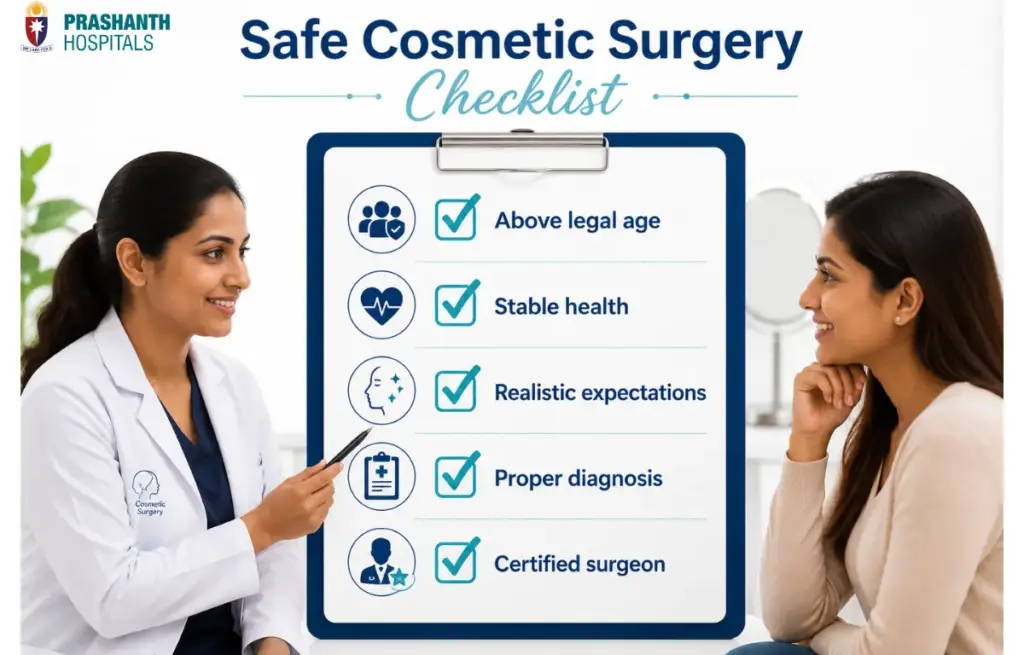
The right age for cosmetic surgery is not decided by the calendar alone. Surgeons weigh several things together before recommending any procedure.
- Physical development and health. Has the body completed its growth? Is the patient in good general health with no conditions that would increase surgical risk? Are there any medications that need to be managed before surgery?
- Emotional readiness. Does the patient have a stable sense of self and realistic expectations? Cosmetic surgery can improve an appearance. It cannot fix a relationship, resolve a mental health struggle, or change how someone fundamentally feels about themselves.
- Surgeons routinely screen for a condition called body dysmorphic disorder, known as BDD. People with BDD experience significant distress about a perceived flaw in their appearance that others may not see or consider minor. Cosmetic surgery rarely satisfies patients with BDD and can sometimes make their distress worse. Patients who show signs of this condition are usually referred for psychological support before surgery is considered. This screening is a standard and important part of a responsible pre-surgical assessment.
- Motivation. Is this decision coming from the patient’s own considered choice, or is it driven by external pressure? A good surgeon will explore this carefully, especially with younger patients.
- Realistic expectations. Does the patient understand what the procedure can and cannot achieve? Unrealistic expectations are one of the most common causes of dissatisfaction after cosmetic surgery, regardless of how well the procedure went technically.
- Lifestyle and follow-through. Can the patient commit to the recovery process, follow post-operative instructions, and maintain the results with healthy habits over time? Smoking history, weight stability, and skin care habits all factor into this assessment.
When all of these align, the timing is usually right. When one or more is missing, waiting is the better choice.
Minimally Invasive Options at Any Age
Not every cosmetic concern requires surgery. Many people find that minimally invasive treatments address what they need at their current stage of life, often with less downtime and lower risk.
Botox relaxes the muscles that cause expression lines. It is commonly started in the late twenties or thirties as a preventive measure for selected patients, though treatment decisions should always be based on individual need rather than age. Hyaluronic acid dermal fillers restore volume and smooth deeper lines. They are temporary and require repeat sessions to maintain results, which is worth understanding clearly before starting treatment.
Laser treatments target skin texture, pigmentation, and early signs of ageing. Chemical peels and microneedling support skin renewal over time.
These options can sometimes delay the need for surgery by years. They are also useful for people who prefer gradual, subtle improvements rather than a single more significant change.
If you are unsure whether you need a surgical procedure or a non-surgical option, a consultation with a plastic surgeon will give you a clear, honest answer based on your actual goals and the current state of your skin and tissues.
Cosmetic Surgery at Prashanth Hospitals, Chennai
At Prashanth Hospitals, our Plastic and Cosmetic Surgery team takes a thorough, patient-first approach to every consultation. Before recommending any procedure, our surgeons assess your health, your goals, your emotional readiness, and whether the timing is genuinely right for you. Screening for conditions like BDD and evaluating surgical fitness across all health factors is a standard part of how we work.
We see patients at every stage of life, from teenagers with long-standing concerns to adults in their sixties looking to restore a more rested appearance. Every consultation begins with an honest conversation about what surgery can achieve, what it cannot, and what the most appropriate path forward looks like for your specific situation.
If you are thinking about cosmetic surgery and want to understand your options clearly and safely, book a consultation with our Plastic and Cosmetic Surgery team at Prashanth Hospitals today.