Quick Migraine Relief Checklist
Before we go into detail, here is what you can do right now:
- Apply a cold compress to your forehead or temples
- Move to a dark, quiet room immediately
- Practice slow, controlled breathing
- Sip coconut water or an electrolyte drink
- Take a pain reliever early — do not wait for the pain to peak
These 5 steps are covered in full below. Read on to understand why each one works and how to do it correctly.
That familiar pull behind one eye. The pressure building on one side of your head. If you have experienced this before, you know a migraine is not something you can simply push through.
Migraines are a neurological condition. According to the World Health Organization (WHO), migraine ranks among the top 10 most disabling conditions in the world. It affects about 1 in 7 people globally. In India, studies estimate that nearly 25 million people experience migraines every year.
The good news is that you do not always have to wait it out.
This guide gives you 5 tips for instant migraine relief that work whether you are at home, at work, or on the go. These are simple, doctor-supported steps backed by clinical experience from Prashanth Hospitals’ neurology team.
What Is Actually Happening During a Migraine?
A migraine is not just a bad headache. It is your brain’s nerve pathways going into overdrive. Pain signals intensify. Blood vessels around the brain change. Your brain becomes extremely sensitive to light, sound, and smell. Even a low hum or a slightly bright screen can feel unbearable.
Most migraines move through four stages:
Prodrome (1 to 2 days before): Mood shifts, neck stiffness, food cravings, frequent yawning. This is the best time to act.
Aura (20 to 60 minutes before): Some people see flashing lights or feel tingling. Not everyone experiences this stage.
Attack: The main pain phase. Can last anywhere from 4 hours to 3 full days without care.
Postdrome: A lingering fatigue and fog after the pain fades, often called the “migraine hangover.”
Studies show that early intervention during the first phase of a migraine attack significantly improves the chances of calming the attack before it reaches full intensity. Acting at the prodrome or aura stage is always more effective than waiting.
What Triggers a Migraine?
Understanding your triggers helps you respond faster. Common ones include:
- Skipping meals or irregular eating times
- Too little or too much sleep
- Dehydration (especially common in Chennai’s heat)
- High stress or sudden release of stress after a long week
- Bright sunlight, screen glare, or fluorescent lighting
- Strong smells like perfume, petrol, or paint
- Hormonal changes in women, particularly around periods
- Caffeine withdrawal if you drink coffee daily
- Weather and pressure changes, including Chennai’s monsoon season
Keep a simple note on your phone. Each time a migraine strikes, write down what you ate, how you slept, and your stress level that day. Patterns often appear within 3 to 4 weeks.
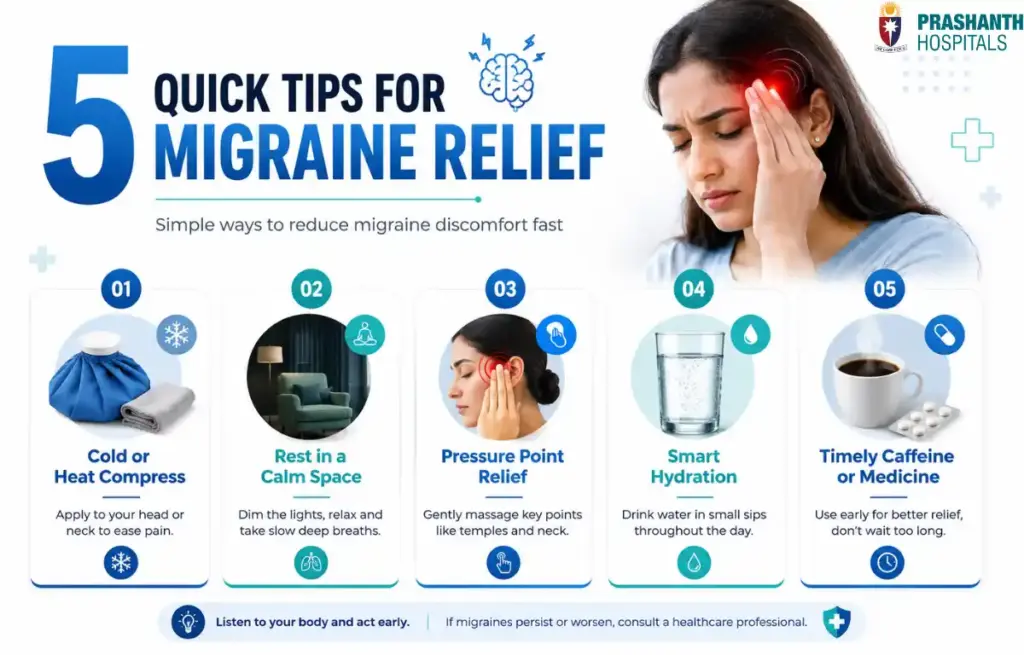
5 Tips for Instant Migraine Relief
Tip 1: Cold and Warm Therapy — Act Within the First 5 Minutes
Temperature therapy is the fastest first step for reducing migraine pain.
A cold compress on the forehead or temples helps calm the throbbing sensation. Cold reduces inflammation and narrows blood vessels, which eases the pulsing pressure you feel.
A warm compress on the back of the neck works differently. It relaxes tight muscles in the neck and shoulders that pull on the head and make migraine pain significantly worse.
How to do it:
- Wrap ice cubes in a thin cloth or use a chilled gel pack. Apply to the forehead or temples for 15 to 20 minutes.
- At the same time, place a warm water bag or warm towel on the back of your neck.
- Rest. Repeat after a 10-minute break if needed.
Never place ice directly on skin. Always use a cloth between the ice and your skin to prevent a cold burn.
No ice pack at home? A cold wet towel works. Even a chilled water bottle pressed against your forehead gives some relief in a pinch.
Best for: Throbbing or pulsating pain, tension-related migraines, migraines worsened by heat.
Tip 2: Find a Dark Quiet Space and Breathe Slowly
During a migraine, your brain is in a state of sensory overload. Even a low noise or dim light can feel amplified. Removing those triggers gives your nervous system the chance to settle.
Step 1: Go to the quietest, darkest room available. Close the curtains. Turn off screens or place your phone face down.
Step 2: Lie down with your head slightly elevated on a pillow.
Step 3: Try 4-7-8 breathing:
- Breathe in through your nose for 4 seconds
- Hold for 7 seconds
- Breathe out slowly through your mouth for 8 seconds
- Repeat 4 to 5 times
This breathing pattern activates your body’s natural calming response. It slows your heart rate and helps reduce the intensity of the pain signals your brain is sending.
Add-on: Place a small drop of peppermint or lavender essential oil on a tissue and breathe it in gently. Many people find this helps with both headache and nausea.
Best for: Stress-triggered migraines, early migraine care at the aura stage, migraines with nausea and light sensitivity.
Tip 3: Press These Pressure Points to Ease the Pain
Pressing on specific points on your body can interrupt pain signals before they take full hold. No tools needed — just your fingers.
LI-4 Point (Hegu): Located in the fleshy web between your thumb and index finger.
- Press firmly using the thumb and index finger of your other hand
- Hold for 1 to 2 minutes
- Release and repeat on the other hand
This is one of the most widely used points for quick relief from head and face pain. It targets nerve pathways directly connected to the pain pathways involved in migraines.
Important: Avoid this point during pregnancy.
GB-20 Points (Base of Skull): Place both thumbs in the two small hollows at the base of your skull, just where your neck meets your head. Apply gentle circular pressure for 1 to 2 minutes. Significant migraine tension accumulates here.
Temple Massage: Use two fingers to make slow, gentle circles on your temples. Light pressure works better during an active attack than pressing hard.
Best for: Migraines at the office or while travelling, situations where lying down is not possible.
Tip 4: Hydrate the Right Way
Dehydration is one of the most common and most overlooked migraine triggers. But during an active attack, plain water alone is often not enough. When your body loses fluids, it also loses electrolytes — minerals like potassium, sodium, and magnesium that your nerves depend on.
What to drink:
- Tender coconut water — natural electrolytes, gentle on an upset stomach
- ORS (oral rehydration solution) diluted in water
- Warm ginger tea — helps with nausea that often accompanies migraines
- Plain water, sipped slowly in small amounts
What to avoid:
- Alcohol — even a small amount worsens an active attack
- Sugary sodas or energy drinks
- Very cold drinks on an empty stomach
The magnesium link: Research has found that people who experience frequent migraines often have lower magnesium levels in the blood. Foods like pumpkin seeds, almonds, bananas, and dark leafy greens are good natural sources. Speak to your doctor before taking supplements.
Best for: How to get relief from migraine pain caused by heat, exercise, or skipping meals.
Tip 5: Use Caffeine or Pain Relief — Timing Is Everything
A small cup of tea or coffee taken at the very first warning sign of a migraine can help. Caffeine gently constricts blood vessels and can boost the effectiveness of common pain relievers. It works best early — not two hours into an attack.
Use caffeine only if you do not drink it every day. If you do, caffeine withdrawal itself may be triggering your migraines.
Over-the-counter options: Paracetamol or ibuprofen, taken as directed, work best when taken in the early stage of an attack. Waiting until the pain is at its worst makes medication significantly less effective.
One important caution: using pain tablets more than 2 to 3 times a week can cause what doctors call a “medication overuse headache.” This actually increases migraine frequency over time. If you are reaching for pain relief more than twice a week, see a neurologist.
Best for: How to get relief from migraine pain in the early stage, infrequent migraine sufferers.
Your 30-Minute Action Plan
Here is how to put all 5 tips for instant migraine relief into a simple timeline:
| Time | Action |
| 0 to 5 minutes | Move to a dark quiet room. Apply cold compress to forehead. Take paracetamol or ibuprofen if available. |
| 5 to 15 minutes | Start 4-7-8 breathing. Press LI-4 pressure point. Sip coconut water or warm ginger tea slowly. |
| 15 to 30 minutes | Warm compress on the back of neck. Try GB-20 pressure point massage. Add peppermint oil on a tissue. |
| 30 to 60 minutes | Stay still. No screens. Continue sipping water. One small cup of tea if pain persists. |
Most mild to moderate migraines respond well within this window when you act early.
Relief Tips for Real-Life Situations
At the office: Dim your screen brightness immediately. Keep a small cold pack in the office fridge. Use noise-cancelling headphones set to silence. The LI-4 pressure point can be pressed discreetly at your desk.
Travelling: Carry an eye mask. Stay hydrated on flights — aircraft air is very dry. Avoid strong perfumes in closed spaces. A travel-sized peppermint oil is easy to carry.
At night: Sleep with your head slightly elevated. Keep the room cool and dark. Avoid phone screens — the light makes night-time migraines significantly worse.
Menstrual migraines: These often arrive just before or during your period and tend to be more intense. Stay extra hydrated in the days leading up. Eat regular meals. If this happens every month, speak to your neurologist about preventive care options.
How to Reduce How Often Migraines Happen
The 5 tips for instant migraine relief above help during an attack. These habits help reduce how frequently attacks occur:
- Sleep and wake at the same time every day, including weekends
- Never skip meals — eat at regular times throughout the day
- Drink 2.5 to 3 litres of water daily, more in summer
- Walk or do gentle yoga for 30 minutes, 4 to 5 days a week
- Use blue light filters on your phone and computer, especially after dark
- Manage daily stress through short breathing exercises or journalling
Consistent small habits work better over time than any single remedy.
When Should You See a Doctor?
Home care helps with mild to moderate attacks. But some migraines need proper medical attention.
See a neurologist if:
- Your headache comes on suddenly and is the worst pain you have ever felt
- You experience vision changes, weakness in your limbs, or difficulty speaking alongside the headache
- A migraine lasts more than 3 days
- You are getting 4 or more migraines a month
- Your usual pain relief is no longer working
- You are having your first-ever severe headache
These could be signs of a more serious condition that needs immediate evaluation.
Meet Our Neurology Team at Prashanth Hospitals
At Prashanth Hospitals, Chennai, our neurology team has helped thousands of patients move from frequent, debilitating migraine attacks to a life that feels manageable again. Here are the three specialists you can consult for expert migraine care.
Dr. Sivaji M
- MBBS, DPM (Diploma in Psychological Medicine), MD (General Medicine), DM (Neurology)
- Senior Consultant Neurologist
- 35+ Years of Experience
Dr. Sivaji M is one of Chennai’s most experienced neurologists. With over three decades in neurology, psychological medicine, and general medicine, he brings depth and precision to managing complex neurological conditions including chronic migraines. He is known for listening carefully and building personalised treatment plans for each patient.
Dr. Preetha P
- MBBS (Sri Ramachandra Medical College) | MD in Internal Medicine (PSG Medical College) | DM in Neurology (Madras Medical College)
- Consultant Neurologist
- 17 Years of Experience
Dr. Preetha P specialises in headache and migraine management directly. Her clinical focus includes epilepsy, headache disorders, movement disorders, non-invasive stroke management, and Botox injections for chronic migraine. With 17 years of experience, her approach is precise, caring, and results-focused. For patients dealing with frequent or severe migraines, Dr. Preetha is the right specialist to consult.
Dr. S. Balasubramaniam
- MBBS, MD (Internal Medicine), DM (Neurology)
- Senior Consultant Neurologist and Stroke Specialist
- 24+ Years of Experience
Dr. Balasubramaniam brings over two decades of neurological expertise to the team. His areas include headache disorders, stroke management, epilepsy, multiple sclerosis, and vertigo and balance disorders. For patients whose migraines come with visual disturbances, dizziness, or neurological symptoms, his specialist care provides both clarity and confidence.
Book an appointment with our neurology team.
Conclusion
A migraine attack does not have to take over your entire day. The moment you feel the first sign, how fast you respond makes all the difference.
Cold therapy calms the throbbing. A dark quiet room and slow breathing settle your nervous system. Pressure point massage interrupts pain signals naturally. Proper hydration corrects a common trigger from within. And early pain relief, used wisely, works far better than waiting.
These are not complicated steps. They are practical tools that work because they address what is actually happening in your body during an attack.
The neurology team at Prashanth Hospitals is here to help you understand your migraines, manage them better, and reduce how often they happen. You deserve to feel well.
This article is for informational purposes only and is not a substitute for professional medical advice. Always consult a qualified doctor for diagnosis and personalised treatment.