Most people glance at their blood pressure reading and forget it within minutes. Two numbers, a nod from the nurse, and you move on. But understanding what those numbers actually mean for your age can help you catch a problem long before it becomes serious.
This guide breaks down what blood pressure means, what counts as normal, and when a reading should send you to a doctor instead of home, including a full blood pressure by age chart and a blood pressure chart by age and gender, so you can see exactly where your own numbers fall.
Normal Blood Pressure by Age
Blood pressure isn’t a fixed number that stays the same your whole life. It naturally shifts as you grow, and knowing where you stand for your age group gives you a much clearer picture than just comparing yourself to a single “ideal” number.
Here’s what normal looks like for children and teens:
| Age Group | Systolic (mm Hg) | Diastolic (mm Hg) |
| Newborns (up to 1 month) | 60 to 90 | 20 to 60 |
| Infants | 87 to 105 | 53 to 66 |
| Toddlers | 95 to 105 | 53 to 66 |
| Preschoolers | 95 to 110 | 56 to 70 |
| School age children | 97 to 112 | 57 to 71 |
| Teenagers | 112 to 128 | 66 to 80 |
For adults, the healthy target does not actually change with age. Under current guidance, 120 over 80 mm Hg is considered normal blood pressure for every adult, whether you’re 25 or 75.
You may come across charts online showing higher “average” numbers for older age groups, sometimes above 130 or even 139 systolic. These are population averages, showing what a lot of older adults happen to measure, not a healthy target to aim for. A reading like 139 over 68 is not normal, it falls into the Stage 1 high blood pressure category no matter your age. Use average readings only to understand that many older adults run higher than ideal, which is exactly why regular checkups matter more as you age.
For children, doctors don’t use a single fixed range like the table above for a real diagnosis. A child’s reading is compared against a percentile chart based on their exact age, height, and sex, since a number that’s normal for a tall ten year old might be high for a shorter one. The ranges above are a general guide only, your pediatrician is the right person to check your child’s specific reading.
What Do the Two Numbers Actually Mean
Every blood pressure reading has two parts, written like 120 over 80. The top number is called systolic pressure. It shows how hard your blood pushes against your artery walls the moment your heart beats. The bottom number is diastolic pressure, and it shows the pressure in your arteries while your heart is resting between beats.
Think of your heart as a pump and your blood vessels as the pipes carrying blood through your body. Systolic is the pressure while the pump is actively pushing. Diastolic is the pressure while the pump takes a short breather. Both numbers matter, and doctors look at the two together rather than picking one over the other.
Blood Pressure by Age Chart
What Is the Average Blood Pressure by Age Chart?
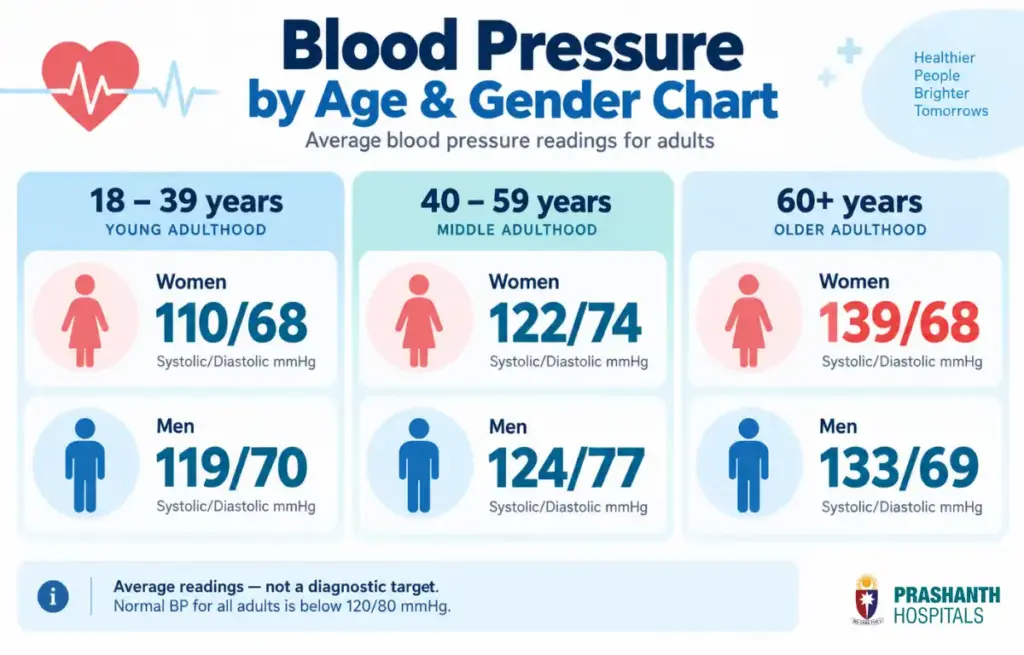
The average blood pressure by age chart shows how typical readings shift as people get older, and how they differ between men and women at each stage. Here’s how it breaks down:
| Age Group | Average Reading, Women | Average Reading, Men |
|---|---|---|
| 18–39 years | 110/68 mm Hg | 119/70 mm Hg |
| 40–59 years | 122/74 mm Hg | 124/77 mm Hg |
| 60+ years | 139/68 mm Hg | 133/69 mm Hg |
A few things stand out here. Men tend to run a little higher than women through early and mid-adulthood, but that gap narrows and even flips after 60, when women’s average readings often overtake men’s. You’ll also notice the 60+ numbers sit well above the 120/80 target, and above 130/80 too.
That’s an important distinction to hold onto: these are population averages, showing what a lot of people in that age and gender group happen to measure, not a healthy number to aim for. A reading like 139 over 68 is not normal, it falls into the Stage 1 high blood pressure category no matter your age or gender. Use these averages only to understand that many older adults, and men in particular through mid-life, tend to run higher than ideal, which is exactly why regular checkups matter more as you age.
For children, doctors don’t use a single fixed range like the table above for a real diagnosis. A child’s reading is compared against a percentile chart based on their exact age, height, and sex, since a number that’s normal for a tall ten year old might be high for a shorter one. The ranges above are a general guide only, your pediatrician is the right person to check your child’s specific reading.
Blood Pressure Categories You Should Know
Beyond age, doctors also sort blood pressure into five general categories. This helps you understand exactly where your number falls, no matter how old you are.
| Category | Systolic | Diastolic |
| Normal | Below 120 | Below 80 |
| Elevated | 120 to 129 | Below 80 |
| High blood pressure, Stage 1 | 130 to 139 | 80 to 89 |
| High blood pressure, Stage 2 | 140 or higher | 90 or higher |
| Hypertensive crisis | Above 180 | and/or above 120 |
Notice the “and/or” there. You don’t need both numbers to be high for this to count. A reading like 185 over 75 still falls into this severe category, even though the bottom number looks fine on its own.
A reading this high doesn’t always mean the same thing for everyone, though. If your number is above 180 over 120 but you feel completely fine, with no chest pain, no shortness of breath, no vision changes, and no confusion or weakness, sit down, rest for a few minutes, and check again. If it’s still high, contact your doctor promptly rather than waiting. But if that high reading comes with any of those symptoms, that’s a true emergency, and you should seek emergency medical care right away rather than waiting to recheck at home.
Why Blood Pressure Tends to Rise With Age
Here’s something that surprises a lot of people. The healthy target doesn’t actually move as you age, but your real numbers often do anyway. Over the years, your artery walls naturally lose some of their flexibility and become a little stiffer. Stiffer arteries mean your heart has to work harder to push blood through them, and that shows up as a higher reading over time.
This is also why doctors sometimes disagree on how strict blood pressure targets should be for older adults. Some feel a 70 year old shouldn’t be held to the same number as a 25 year old, while others argue the healthy range should stay consistent no matter your age.
It helps to know the difference between two terms here. Under 120 over 80 is what counts as normal blood pressure. For adults already managing high blood pressure, current guidance sets the overall treatment goal at under 130 over 80, though your doctor may adjust this based on your age and health history. Normal is what a healthy reading looks like, the treatment goal is what someone managing hypertension is working toward, and the two aren’t the same thing.
Blood Pressure During Pregnancy and With Diabetes
Two groups need to pay closer attention to their numbers than most.
If you’re pregnant, a reading of 140 over 90 or higher on two separate occasions, taken at least four hours apart, is generally considered high blood pressure in pregnancy, especially after the twentieth week. A reading of 160 over 110 or higher is considered severe and needs urgent medical attention, not a wait and watch approach. This matters because high blood pressure in pregnancy can be an early sign of preeclampsia, which is why it gets checked at every single prenatal visit, even when you’re feeling completely fine.
If you have diabetes, blood pressure management tends to be more closely watched, since high blood sugar and high blood pressure together put extra strain on your heart and kidneys. Many doctors work toward a treatment goal of under 130 over 80 for adults with diabetes, but this is an individual goal your doctor sets based on your full health picture, not a fixed rule that applies the same way to everyone.
High Blood Pressure vs Low Blood Pressure
High blood pressure often shows no symptoms at all, which is exactly why it’s sometimes called the silent problem. Most people find out they have it during a routine checkup, not because they felt unwell.
Low blood pressure tends to be the opposite. It can announce itself through dizziness, blurred vision, feeling unusually tired, or even fainting. These symptoms can have several different causes though, not just low blood pressure, so it’s worth getting them checked rather than assuming you know the reason. Checking your actual numbers, and talking to a doctor about what else might be going on, is the only reliable way to know for sure.
Left unmanaged for years, high blood pressure raises your risk of heart attack, stroke, and kidney disease. Low blood pressure, while less commonly dangerous, can still cause falls if it makes you feel faint.
How to Check Your Blood Pressure Correctly at Home
Home monitoring is a great way to track your numbers between doctor visits, but the way you take the reading actually affects the result.
- Sit calmly in a chair with your back supported and both feet flat on the floor.
- Rest quietly for about five minutes before you check.
- Keep your arm supported at roughly heart level.
- Avoid caffeine, smoking, or exercise for at least thirty minutes beforehand.
- Don’t talk or move while the cuff is inflating.
- Take two readings a minute or two apart. If the two numbers are close, use the average. If they’re noticeably different, take a third reading and average all three instead.
- Write down the number along with the time of day, since blood pressure naturally shifts throughout the day.
A monitor that wraps around your upper arm gives more reliable results than the wrist or finger types, so it’s worth investing in the right kind of device.
When You Should See a Doctor
Not every high or low reading needs a same day visit, but a few situations do.
See a doctor soon if your readings stay above 130 over 80 across several days, or if your numbers swing widely between high and low without explanation. The same goes if you notice dizziness, fainting, chest pressure, or shortness of breath alongside an unusual reading.
A reading above 180 over 120 with no symptoms is still serious and needs prompt medical advice, but it’s the combination of that reading with symptoms like severe headache, vision changes, chest pain, shortness of breath, or sudden weakness and confusion that turns it into a true emergency needing immediate care.
If you’re pregnant, have diabetes, or have a family history of heart disease, it’s worth checking in with your doctor about how often you personally should be monitoring, since your ideal check up schedule may look different from someone without these factors.
A Final Word
Your blood pressure tells a story about your heart health that builds over years, not days. Knowing what’s normal for your age, checking your numbers regularly, and knowing when a reading needs medical attention puts you back in control of that story.
If your recent readings have you concerned, or if it’s simply been a while since your last check, Prashanth Hospitals’ cardiology team can help you understand your numbers and build a plan that fits your specific health picture.
Use this blood pressure by age chart as a starting point, not a diagnosis.