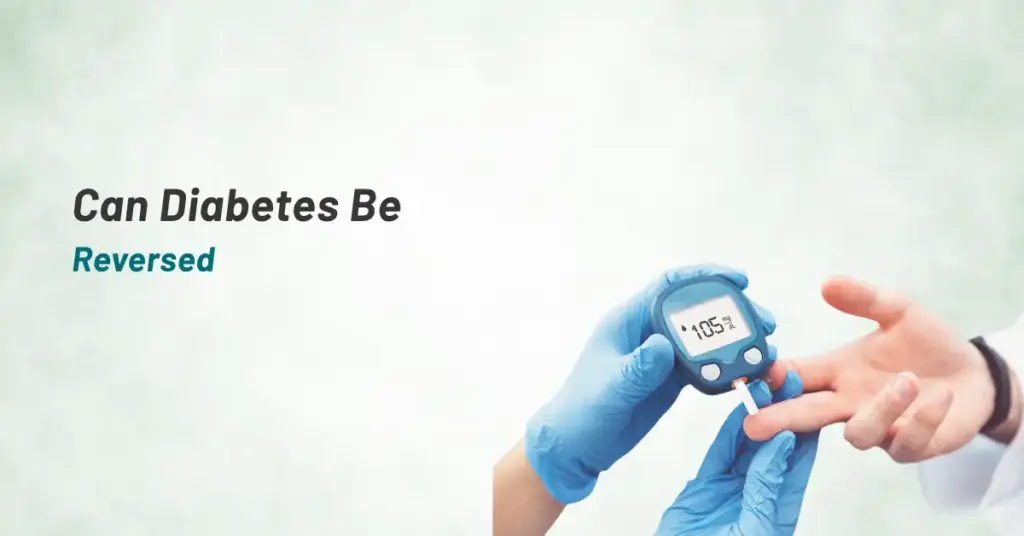
One of the first questions many people ask after being diagnosed with diabetes is, “Will I have this for the rest of my life?”
It is a natural concern. A diabetes diagnosis can immediately bring worries about lifelong medicines, food restrictions and future complications. But the diagnosis itself does not tell us exactly how the condition will progress.
For some people with prediabetes, blood sugar can return to the normal range and the progression to type 2 diabetes may be prevented. Some people with type 2 diabetes can achieve remission when blood sugar improves substantially and remains below the diabetes range without glucose-lowering medication. Type 1 diabetes is different and cannot currently be reversed through lifestyle changes.
So the more useful question is not simply, “Can diabetes be reversed?” It is “How much can my health improve, and what can I do to make that improvement last?”
Can Diabetes Actually be Reversed?
The answer depends on the type of diabetes and the individual.
With prediabetes, early lifestyle changes can significantly reduce the risk of developing type 2 diabetes. With type 2 diabetes, some people can achieve remission through substantial and sustained improvements in metabolic health.
For type 1 diabetes, however, lifestyle changes cannot replace the insulin the body needs because the condition results from autoimmune destruction of insulin-producing beta cells.
This distinction is important because “diabetes” is not one single condition with one single outcome.
Reversal, Remission and Cure Mean Different Things
The word reversal is commonly used in everyday health discussions, but doctors generally use remission when describing type 2 diabetes that has improved to a non-diabetic range without medication.
| Situation | What it means |
| Prediabetes improvement | Blood sugar returns to a healthier range and the risk of progressing to diabetes is reduced |
| Type 2 diabetes remission | HbA1c below 6.5% sustained for at least 3 months in the absence of usual glucose-lowering medication |
| Cure | Permanent elimination of the underlying disease |
Remission is therefore not the same as being permanently cured. Blood sugar can rise again, particularly if the factors that contributed to metabolic dysfunction return or the body’s insulin-producing capacity changes over time.
Why Do Some People Achieve Remission While Others Do Not?
There is no single factor that determines whether remission will occur — several factors influence its likelihood, including how long someone has had diabetes, how much weight loss is achieved, how well the pancreas’s insulin-producing (beta) cells are still functioning, baseline metabolic health, and prior treatment history.
The duration of diabetes is one consideration. Earlier in the course of type 2 diabetes, the pancreas may retain more insulin-producing capacity. As the condition progresses, the pancreas may gradually struggle to produce enough insulin to compensate for insulin resistance.
Weight and metabolic health can also influence the outcome. For people carrying excess weight, sustained weight loss can improve insulin sensitivity and may increase the likelihood of remission — though it is not a strict requirement, since some people achieve remission without major weight loss, and type 2 diabetes can also occur in people who are not overweight.
Perhaps most importantly, the improvement has to be sustainable. A highly restrictive diet may produce impressive numbers for a short period, but long-term health depends on changes that can realistically become part of everyday life.
And even when remission is unlikely, there is still plenty to gain. Better glucose control, improved fitness and lower cardiovascular and metabolic risk are meaningful outcomes in their own right.
What Happens Inside the Body When Type 2 Diabetes Improves?
To understand remission, it helps to look briefly at what happens in type 2 diabetes.
Insulin helps glucose move from the bloodstream into the body’s cells, where it can be used for energy. In type 2 diabetes, the cells become less responsive to insulin, a problem known as insulin resistance.
The pancreas initially compensates by producing more insulin. Over time, however, it may struggle to keep up with the body’s demand — though insulin resistance and beta-cell dysfunction together drive this process, rather than either one alone.
When metabolic health improves, the body’s response to insulin can improve as well. This is one reason that sustained changes in physical activity, food habits and weight, when excess weight is present, can have effects beyond simply lowering a blood sugar reading.
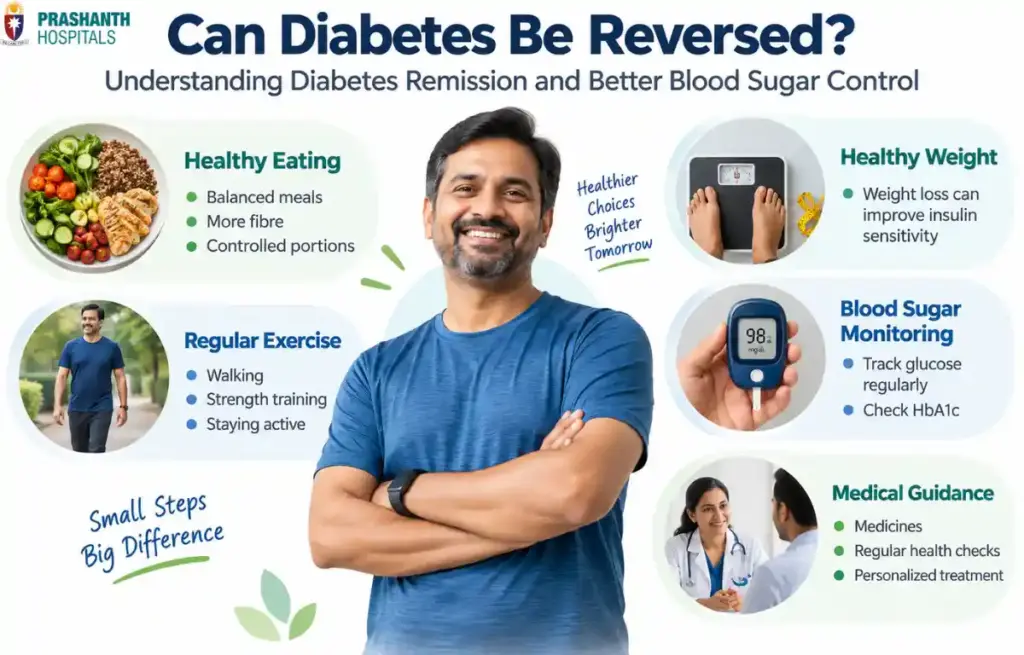
What Can You Actually Do to Improve Your Chances?
There is no single food, supplement or exercise that reverses diabetes. The strongest approach is usually a combination of changes that can be maintained over time.
Start with the Overall Pattern of Eating
A diabetes-friendly diet does not require eliminating every carbohydrate or following an extreme food plan.
Focus on more fibre-rich and minimally processed foods, appropriate portions and balanced meals. Vegetables, pulses, whole grains and suitable protein sources can form the foundation of a healthier eating pattern, while reducing excess added sugar and highly processed foods can make glucose and weight management easier.
The important question is not “Can I follow this diet for one month?” but “Can I continue eating this way years from now?”
Make Regular Movement part of Daily Life
Physical activity helps muscles use glucose more effectively and can improve insulin sensitivity.
Walking is a practical starting point for many people and can be built into everyday routines rather than treated as a separate task.
Resistance exercise can complement aerobic activity by helping maintain or build muscle, which plays an important role in glucose metabolism.
Reducing prolonged sitting also matters: short periods of movement throughout the day can make an otherwise sedentary routine more active.
The appropriate exercise plan depends on age, fitness, medications and other health conditions. People with diabetes complications (such as neuropathy or eye disease) or certain cardiovascular conditions may need medical guidance before starting vigorous exercise.
Address Excess Weight when it is Relevant
For people who are overweight or living with obesity, substantial and sustained weight loss can improve insulin sensitivity and may help some people with type 2 diabetes achieve remission.
But weight should never become the only measure of success. Someone with a healthy body weight can still have type 2 diabetes and may need a different approach.
For some patients, medical weight management, including GLP-1 receptor agonists and newer dual GIP/GLP-1 agonists — can support substantial weight loss alongside lifestyle changes, and this combination is increasingly recognised as a route to improved control or, in some cases, medication-free remission. Whether this approach is appropriate depends on individual health factors and should be discussed with your doctor.
Don’t Overlook Sleep and Routine
Sleep, stress and daily routines can influence eating behaviour, physical activity and overall metabolic health. Diabetes management is therefore not about one perfect meal or one intense workout.
It is about creating a pattern that the body can benefit from repeatedly.
If My Sugar Becomes Normal, Can I Stop My Medicine?
Not on your own.
A few normal glucose readings do not mean that diabetes has gone into remission. HbA1c provides a broader picture of average blood glucose over approximately the previous 2–3 months, with the most recent few weeks weighted more heavily than earlier ones, and is commonly used to assess longer-term control.
If glucose control improves significantly, a doctor may sometimes reduce or change medication. But that decision depends on the person’s HbA1c, glucose pattern, treatment history, other health conditions and the medicines being used.
Some people with type 2 diabetes may eventually achieve remission without glucose-lowering medication. Others may continue to need medication despite making excellent lifestyle changes.
It’s also worth noting that people taking insulin or certain other glucose-lowering medicines may need their doses adjusted alongside significant changes in diet, exercise or weight, otherwise blood sugar can drop too low. This is another reason lifestyle changes should be made in coordination with a doctor, not just monitored after the fact.
Needing medication is not a failure.
How do you Know Diabetes is Really Improving?
Feeling better, losing weight or exercising more are all positive changes, but none of them alone proves remission.
Improvement needs to be assessed through objective measurements over time.
For type 2 diabetes remission, the accepted international consensus definition is an HbA1c below 6.5% sustained for at least 3 months in the absence of usual glucose-lowering medication.
That means:
- One normal glucose reading is not remission.
- Weight loss alone is not remission.
- Feeling healthier is not remission — remission is a lab-defined state, not something judged by symptoms.
- Having an excellent HbA1c while still taking medication is good glucose control, but it does not meet the formal definition of remission.
The broader picture matters too. Blood pressure, cholesterol, kidney health, eye health, nerve health, weight where relevant and cardiovascular risk all form part of good diabetes care.
Can Diabetes Come Back After Remission?
Yes.
Remission should not be treated as a permanent finish line.
Blood sugar may rise again if significant weight is regained, physical activity decreases, metabolic health worsens, or the pancreas gradually loses some of its insulin-producing capacity as part of the disease’s natural progression, weight regain is one contributor among several, not the only reason remission can end.
That is why people who achieve remission should continue healthy habits and have appropriate follow-up.
The aim is not simply to reach remission. It is to maintain the health improvements that made remission possible.
What About Diabetic Neuropathy? Can Nerve Damage Be Reversed?
Diabetic peripheral neuropathy, nerve damage caused by prolonged high blood sugar, most often affecting the feet and hands — is one of the most common chronic complications of diabetes, and one of the questions patients ask most often once glucose control becomes part of the conversation.
The honest answer is that established diabetic neuropathy usually cannot be fully reversed, especially once nerve damage is advanced. However, the picture is not entirely fixed:
- Early, small-fiber sensory neuropathy has the best chance of improvement. When severe hyperglycemia or wide swings in blood sugar are identified and corrected early — before larger nerve fibers are involved — some patients experience a genuine reduction in symptoms such as tingling, burning or numbness. In some cases, this early small-fiber damage can improve significantly with sustained normalization of glucose.
- Progression can often be reduced, even when damage already present cannot be undone. Glucose control is the single most modifiable factor, though blood pressure, cholesterol, smoking and kidney health also influence how neuropathy progresses. This is one of the strongest reasons consistent glucose management matters, independent of whether remission is achieved.
- Symptom management matters separately from reversal. Pain relief, foot care, and monitoring for complications (ulcers, infections) are essential regardless of whether the nerve damage itself improves.
- Prevention and risk-factor control matter more than screening alone. Managing blood sugar, blood pressure and cholesterol reduces the risk of neuropathy developing in the first place. Regular screening and foot checks don’t prevent neuropathy, but they catch it early — while damage is still limited and more likely to respond to treatment.
In short: diabetic neuropathy is best thought of as a condition to prevent and slow, with a real but limited window for symptom improvement in early, small-fiber cases — not one to expect to reverse once established. This is exactly why routine foot and nerve checks are part of standard diabetes follow-up, not an optional extra.
What If Diabetes does not Go Into Remission?
This is an important part of the conversation because remission is not the only successful outcome.
A person may never meet the formal criteria for remission and still substantially improve their long-term health.
Better glucose control can reduce the risk of diabetes-related complications, including neuropathy. Managing blood pressure and cholesterol, staying physically active, maintaining a healthy weight where appropriate and attending recommended kidney, eye and foot checks are equally important.
In other words, success can mean:
- Better glucose control: Keeping blood sugar closer to the recommended target can reduce long-term risk even when remission is not achieved.
- Lower overall health risk: Managing blood pressure, cholesterol and other cardiovascular risk factors adds protection beyond glucose control.
- A healthier, more sustainable routine: Improved food habits, fitness and daily activity can benefit health regardless of whether the diagnosis disappears.
When Should You Speak to a Doctor?
Diabetes needs an individualised approach. Medical guidance becomes particularly important when:
- You have recently been diagnosed: Knowing the type of diabetes, your treatment goals and your risk factors provides a clear starting point.
- Your blood sugar remains high: Persistent elevation may indicate that your current treatment needs to be reviewed.
- You want to reduce or stop medication: This should be based on sustained glucose control and medical assessment, not a few normal readings.
- You are considering significant weight loss: A structured plan can take nutrition, medication and other health conditions into account.
- You notice signs of diabetic neuropathy or other complications: Tingling, burning, numbness or reduced sensation in the feet or hands, new vision changes, foot wounds that heal slowly, or other concerning symptoms should be assessed promptly — earlier evaluation gives the best chance of slowing nerve damage.
Talk to our diabetes and endocrinology team at Prashanth Hospitals to understand your HbA1c, your remission potential and a plan built around your health —book a consultation today.
The Bottom Line
A diabetes diagnosis tells you where your blood sugar is today. It does not tell you exactly where your health has to be years from now.
Prediabetes can often be improved. Some people with type 2 diabetes can achieve remission through substantial and sustained improvements in metabolic health. Others may continue to need medication but can still achieve excellent glucose control and reduce their risk of complications, including diabetic neuropathy.
Type 1 diabetes cannot currently be reversed through lifestyle changes, but appropriate treatment and healthy habits remain essential.
The goal is not to chase the label of being “diabetes-free.” The goal is to improve what can be improved, protect what can be protected and build a treatment plan that can be sustained for the long term.
That is meaningful progress, and it starts with understanding what is possible rather than assuming that a diagnosis has already decided the future.