Some heart blockages do not respond to standard treatment. A regular balloon may not be able to cross them or fully open them. For these tough cases, doctors can use a more advanced option called laser angioplasty. If you are looking for a laser angioplasty hospital in Chennai, knowing how this procedure works can help you make a confident choice about your heart care.
At Prashanth Hospitals, our cardiac team offers laser angioplasty for patients whose blockages are too complex for routine methods.
What is Laser Angioplasty?
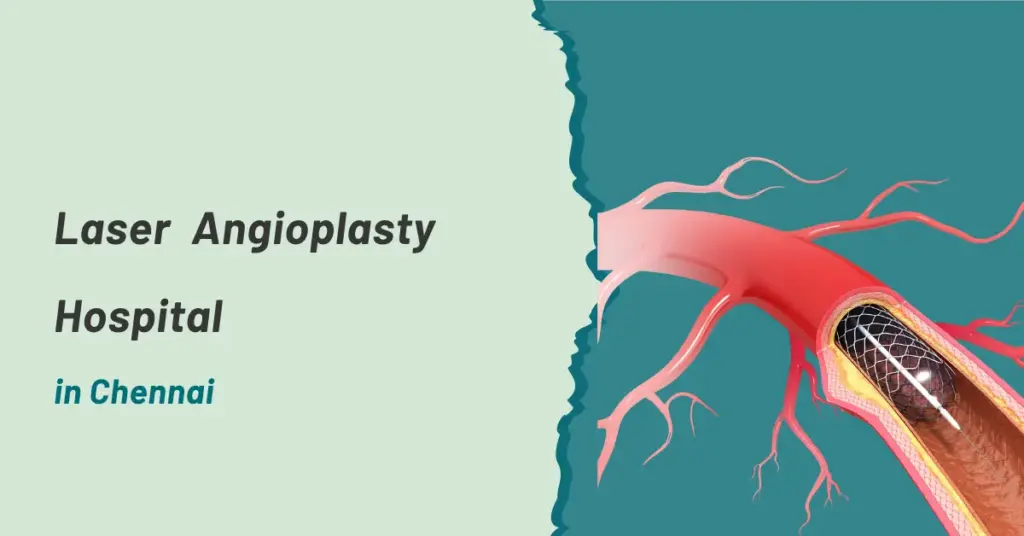
Laser angioplasty, also called Excimer Laser Coronary Atherectomy (ELCA), uses a laser at the tip of a thin tube called a catheter. The laser sends short bursts of energy that break down soft plaque, blood clots, and scar tissue inside the heart arteries. Once the blockage is softened, a balloon and stent are usually used to fully restore blood flow.
It is mainly used for:
- Blockages that a standard balloon cannot cross
- Scar tissue inside a stent placed earlier, called in stent restenosis
- Blockages that contain blood clots
Very hard, calcium filled blockages usually need other tools, such as rotational atherectomy or intravascular lithotripsy. Your cardiologist will choose the right method based on your scan results.
How is it Different from Balloon Angioplasty?
In regular balloon angioplasty, a small balloon is inflated to push plaque against the artery wall. This works well for most blockages, but not all.
Laser angioplasty works differently. Instead of pushing the plaque aside, the laser breaks down the softer parts of the blockage and creates a path. Doctors then follow with a balloon and stent, often guided by imaging from inside the artery (IVUS or OCT), to keep the artery open for the long term.
Benefits of Laser Angioplasty
- Opens blockages that a balloon alone cannot cross or treat
- Minimally invasive, done through a small opening instead of surgery
- Short hospital stay, usually one to two days
- Precise treatment aimed only at the blockage, guided by live imaging
- Helps treat stent scar tissue, clot filled blockages, and failed stents
For patients who were told their blockage is too complex to treat, laser angioplasty can open up new options.
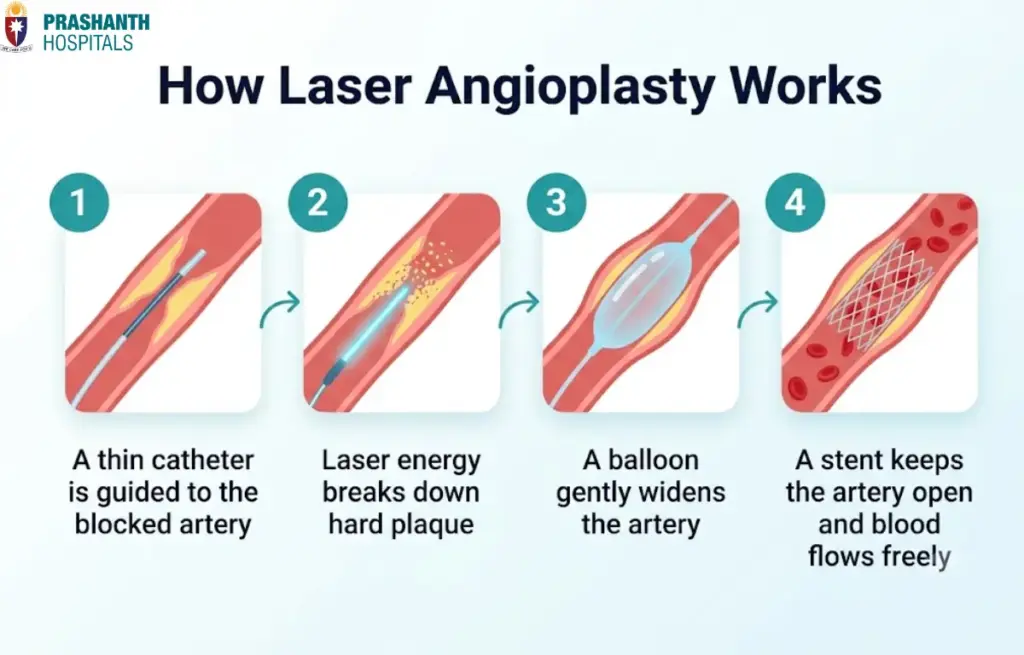
The Procedure Step by Step
The procedure is done in a cardiac cath lab under local anaesthesia. You stay awake but do not feel pain at the insertion site.
- Access: A thin catheter is inserted through a small opening, usually in the wrist or groin.
- Reaching the blockage: Using live X-ray imaging, the doctor guides the catheter to the blocked artery.
- Laser treatment: The laser sends short pulses of energy to break down plaque, clot, or scar tissue. The artery is flushed with saline throughout to keep the area clear.
- Preparing the vessel: The treated tissue turns into tiny particles and gas bubbles, which are mostly cleared by the bloodstream. A balloon is then used to open the passage further.
- Stent placement: In most cases, a stent is placed to keep the artery open.
- Recovery room: You are monitored for a while before moving to a regular room.
The whole procedure usually takes one to two hours.
Who Needs this Procedure?
Laser angioplasty may be advised if you have:
- A blockage that a standard balloon cannot cross
- Scar tissue inside an old stent
- A heart attack with a large clot, in selected cases
- A stent that failed or did not expand fully
- Certain complex blockages, including some long standing complete blockages (chronic total occlusions)
Your cardiologist will study your angiogram, and sometimes IVUS or OCT scans, before recommending it. This procedure suits specific types of blockages, not every case. You can also ask for a second opinion from another interventional cardiologist.
Recovery and Aftercare
Recovery is much quicker than after open heart surgery. Most patients stay in hospital for one to two days, and many can walk within 24 hours.
After you go home:
- Avoid heavy lifting and hard exercise until your doctor says it is safe.
- If a stent was placed, take your blood thinning medicines exactly as prescribed. This lowers the risk of clots forming around the stent.
- Attend all follow up visits so your doctor can check your artery is healing well.
- Call your doctor right away if you have chest pain, swelling at the insertion site, or shortness of breath.
Healthy habits also protect your heart for the long term. These include a heart friendly diet, staying active within your doctor’s advice, keeping blood pressure and cholesterol in control, and not smoking.
Risks and Safety
Laser angioplasty is a specialised procedure. Compared to routine balloon angioplasty, it carries a higher risk of problems such as a tear or small hole in the artery wall. This is why it is used only for specific blockages. Flushing the artery with saline during the procedure is a standard safety step, because using the laser in the presence of blood or contrast dye can injure the vessel.
It may not be suitable if your arteries are very twisted or sharply angled, if there is an existing untreated tear in the artery, or if the blockage is in an unprotected left main artery.
Before the procedure, your team will review your medical history, medicines, and allergies. Blood tests and an ECG are usually done. Let your doctor know about any bleeding problems or kidney conditions so the safest plan can be made for you.
Laser Angioplasty Hospital in Chennai: Prashanth Hospitals
Prashanth Hospitals is proud to be South Chennai’s first laser angioplasty facility. Our cath lab combines IVUS and OCT imaging with a laser system designed for balloon uncrossable and other selected complex blockages. For very hard, calcium filled blockages, we also offer intravascular lithotripsy, which may be used alongside or instead of laser based on your scans.
Our interventional cardiology team also uses laser angioplasty in high risk cases. For example, in patients with a very weak heart and a complex blockage, the laser can be combined with a heart support pump such as Impella during the procedure. Every case is planned around the patient’s heart function, imaging, and overall health.
With over 20 years of experience, 400+ beds, 200+ doctors, and more than 1.5 lakh patients treated, our team is ready to handle complex heart cases, from emergency care and diagnosis to treatment and recovery.
Book Your Consultation Today
If you have been told your heart blockage is too complex to treat, a second opinion may help. Book a consultation with the interventional cardiology team at Prashanth Hospitals by calling 08069595557. You can also read more about our Excimer Laser Angioplasty (ELCA) service.