You are about to bring your baby home for the first time. Or your toddler is due for vaccinations and you are not sure you are happy with the current doctor. Or a friend has recommended someone new and you want to know whether they are right for your family.
Whatever the situation, choosing the best paediatrician for your child is one of the most important healthcare decisions you will make as a parent. This doctor will be the person you call when your baby has a fever at midnight. They will track your child’s growth month by month. They will give you honest answers when you are worried and reassurance when you need it.
Getting this choice right from the beginning saves time, reduces stress, and builds a healthcare relationship that can support your child from birth through to adulthood.
This guide covers everything you need to consider: what a paediatrician actually does, when to start looking, what to look for, and what questions to ask before you decide.
What Does a Paediatrician Do?
A paediatrician is a doctor who specialises in the health and development of children from birth to 18 years of age. Their training goes far beyond treating common childhood illnesses. They monitor physical growth, track developmental milestones, administer vaccinations according to the Indian Academy of Paediatrics (IAP) schedule, manage chronic conditions, and provide guidance to parents on nutrition, sleep, behaviour, and child development at every stage.
In India, paediatric care typically covers the full period from birth through to 18 years. This includes newborn assessments in the first days of life, monthly check-ups during infancy, annual well-child visits through childhood, and health support into adolescence.
A paediatrician differs from a family physician in focus. A family physician provides care to patients of all ages. A paediatrician’s training and practice is dedicated entirely to children. For parents who want a doctor with deep specialist knowledge of childhood health, growth, and development, a paediatrician is the appropriate choice.
When Should You Choose a Paediatrician?
The ideal time to choose a paediatrician is during the third trimester of pregnancy, ideally before 34 to 36 weeks.
Starting your search early gives you time to research options, meet a doctor if needed, and have everything in place before your baby arrives. Your newborn will need a health assessment within 24 to 48 hours of birth and regular follow-up visits in the weeks that follow. Knowing who your doctor will be from day one removes one significant source of stress during an already busy period.
If you have not chosen a paediatrician before your baby is born, do not worry. You can still make this decision in the early weeks. Many parents revisit this choice after their first few appointments if they feel the doctor is not the right fit for their family.
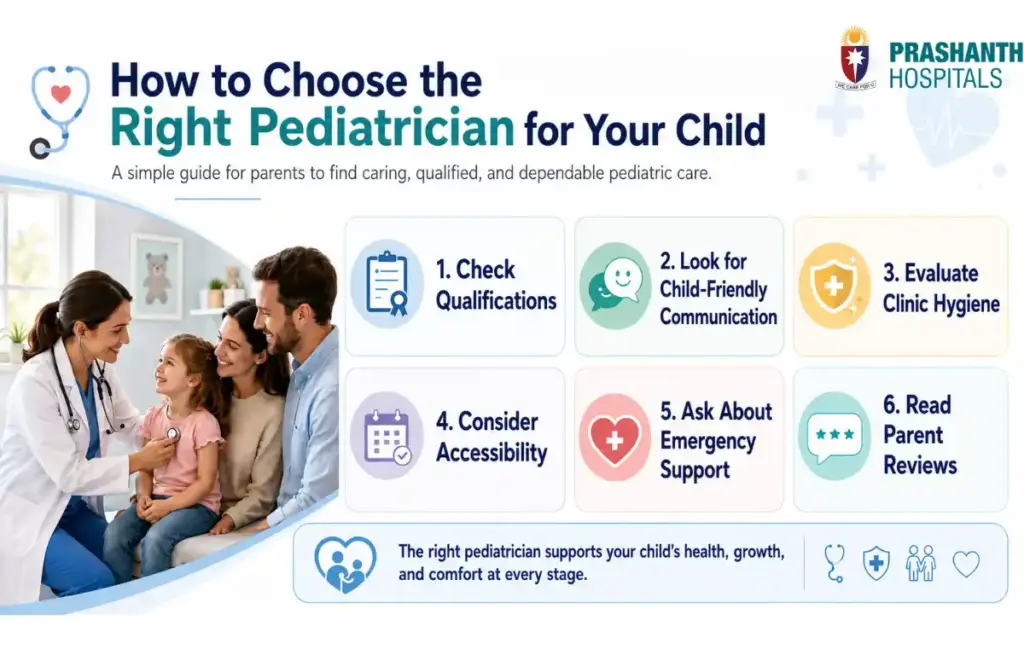
6 Things to Look for When Choosing a Paediatrician
There is no single correct way to choose a paediatrician. What matters most is finding a doctor who is clinically competent, communicates well, and feels right for your child and your family. These six factors give you a structured way to evaluate your options.
1. Qualifications and Clinical Experience
A paediatrician’s training and credentials form the foundation of their ability to care for your child safely and effectively.
Look for a doctor with a recognised postgraduate qualification in paediatrics, such as an MD in Paediatrics or DNB Paediatrics. Board certification indicates that the doctor has completed the required training and assessment in their specialty. If your child has a specific health concern, such as asthma, developmental delay, or a congenital condition, it is worth asking whether the doctor has additional experience or a special interest in that area.
Clinical experience matters because it builds pattern recognition. An experienced paediatrician has managed a wide range of conditions across different age groups, which helps them make sound decisions more quickly and reassure parents more effectively during difficult moments.
That said, qualifications and experience alone are not enough. How a doctor communicates and relates to your child matters just as much.
2. How the Doctor Interacts With Your Child
A medical examination that feels routine to an adult can be frightening to a young child. A good paediatrician understands this and adjusts accordingly.
Watch how the doctor behaves during your child’s consultation. Do they greet your child directly? Do they use language that is appropriate for the child’s age? Are they patient when a toddler is uncooperative or a school-aged child is anxious? Do they explain what they are going to do before they do it?
Small actions make a significant difference to a child’s experience at the doctor. A paediatrician who takes time to engage a nervous child, speak calmly, and make the visit feel safe builds trust over time. Children who feel comfortable with their doctor are more likely to cooperate with examinations and less likely to dread healthcare visits.
This comfort level is worth observing from the very first appointment.
3. Communication With Parents
Your confidence in your child’s healthcare depends significantly on how well your paediatrician communicates with you.
A good paediatrician listens carefully without rushing. They explain diagnoses and treatment plans in language that is easy to understand. They welcome questions and answer them honestly. They discuss options rather than simply issuing instructions. And they help you feel informed and capable, not anxious or confused, when you leave the consultation.
Consider how comfortable you feel asking questions. If you leave a consultation with doubts you were hesitant to raise, or feeling that your concerns were not properly heard, that is important information about whether this is the right doctor for your family.
Communication should feel like a partnership. You know your child. The paediatrician has the medical knowledge. The best outcomes come from both working together.
4. Location and Availability
Children do not fall ill at convenient times. A high fever on a Sunday morning, an ear infection at 7 pm, a rash that appears the night before a family holiday. These things happen, and when they do, access to your doctor matters.
Choose a clinic that is reasonably close to your home, workplace, or your child’s school. Shorter travel times matter particularly when you have a sick infant or a young child who is miserable and unwell.
Before making your final decision, find out:
- How far in advance appointments need to be booked
- Whether same-day appointments are available for urgent illnesses
- What the clinic’s operating hours are, including whether they see patients on weekends
- Whether teleconsultation is available for appropriate concerns
- How to reach the practice for medical advice between appointments
A paediatrician who is accessible and supported by a well-organised appointment system reduces the stress of managing childhood illness significantly.
5. Emergency and After-Hours Support
Even with the best planning, paediatric emergencies happen. Knowing in advance what your doctor’s arrangement is for after-hours and emergency situations gives you clarity exactly when you need it most.
Ask the practice directly. Is there an on-call paediatrician available outside clinic hours? Does the practice have a clear process for urgent appointments? Is the doctor affiliated with a hospital that provides 24-hour paediatric emergency care?
For newborns and young infants especially, having a clear answer to these questions before a crisis occurs is genuinely valuable. The middle of the night is not the time to be searching for information you could have found in advance.
6. The Overall Practice Environment
The quality of the clinic environment is worth assessing separately from the doctor themselves.
During your first visit, take note of the waiting area. Is it clean? Is it reasonably child-friendly? Are hygiene standards maintained? A clinic environment that feels safe and well-maintained reflects the standards the practice sets for itself.
Pay attention to the non-clinical team as well. Are reception staff helpful and organised? Are appointment times respected? Is the patient flow managed efficiently? These factors may seem minor when a child is well, but they matter considerably when you are managing a sick and unsettled child and a long unexplained wait in a disorganised clinic makes everything harder.
Additional services worth asking about include routine IAP vaccinations, developmental screening, growth charts and records, teleconsultation availability, and whether electronic health records are maintained for continuity of care.
Asking Other Parents
Personal recommendations from parents you trust are one of the most useful starting points when looking for a paediatrician. Other parents can tell you things that are not visible in a clinic listing or on a hospital website: how the doctor actually communicates, whether the waiting times are genuinely reasonable, and whether children seem comfortable during appointments.
Online reviews can add context, but interpret them carefully. A small number of reviews, positive or negative, rarely reflects the full picture. Look for consistent patterns across multiple reviews rather than reacting to individual opinions.
Personal recommendations should guide your search and help you build a shortlist. The final decision should be made based on your own direct experience with the doctor and the practice.
What to Ask at Your First Paediatric Consultation
Meeting a paediatrician before committing gives you a chance to assess the fit directly. Most paediatric practices welcome an initial consultation for this purpose. Here are practical questions worth asking:
- What are your qualifications and how long have you been practising paediatrics?
- Which hospital are you affiliated with for admissions or emergencies?
- How is the IAP vaccination schedule managed at your clinic?
- What is your process for same-day appointments during acute illness?
- How can I reach the practice for non-emergency medical advice outside clinic hours?
- How do you prefer to communicate with parents between appointments?
- Do you have experience managing children with the specific condition my child has?
The answers matter. So does how the conversation feels. A paediatrician who is patient, thorough, and unhurried in a first consultation is likely to bring those same qualities to every appointment that follows.
Is This the Right Doctor for Your Child?
After qualifications, recommendations, and practical considerations have been assessed, one question still needs an honest answer. Does this feel like the right doctor for your specific child and your specific family?
Every child is different. A quiet, anxious child needs a doctor with particular patience and gentleness. An active, curious child may respond well to a doctor who engages them directly and explains what is happening. Every parent is also different. Some want detailed explanations and involvement in every decision. Others prefer clear, concise guidance and trust the doctor to direct care.
During your first few consultations, pay attention to whether your child relaxes over time rather than becoming more anxious. Notice whether you leave appointments feeling informed and confident. Notice whether your questions are welcomed. Notice whether your concerns, even the ones that may seem minor, are taken seriously.
Trust between a family and a paediatrician builds gradually through consistent, positive experiences. When it develops well, that relationship becomes one of the most reliable sources of support in your child’s early years.
Paediatric Care at Prashanth Hospitals, Chennai
At Prashanth Hospitals, our Paediatrics and Neonatology department provides specialist care for children from the first hours of life through to adolescence. Our team of paediatricians and neonatologists follow the IAP vaccination schedule, conduct developmental and growth assessments, and manage the full range of childhood illnesses and conditions.
For newborns requiring specialist support, our Neonatology unit provides dedicated care for premature infants and babies with complex medical needs from birth.
Our paediatric emergency services operate around the clock. If your child needs urgent care outside normal clinic hours, our team is available to assess and manage the situation promptly, with the support of our wider multi-specialty team when specialist input is required.
If you are looking for a paediatrician in Chennai and want to understand how our team can support your child’s health, book a consultation with our Paediatrics and Neonatology department at Prashanth Hospitals today.