Every vaccine your baby receives is protection you’re giving them before they need it.
Quick Answer
A baby’s vaccination schedule in India starts at birth and continues through early childhood to protect against several serious diseases. The vaccination chart for babies in India includes vaccines recommended under the Government of India’s Universal Immunization Programme (UIP), which provides key vaccines free of cost at government health facilities. Pediatricians may also recommend additional vaccines based on the Indian Academy of Pediatrics (IAP) schedule. Following the recommended timeline helps your baby’s immune system build protection when it is needed most.
Why Do Babies Need So Many Vaccines?
Within the first year, babies receive several rounds of vaccines, which can feel like a lot to new parents. But this timing isn’t random.
Newborns get some temporary protection from antibodies passed on by their mother during pregnancy. This protection fades over the first few months, and babies become more dependent on their own immune system. Vaccines help close this gap by preparing the immune system in advance, so it can recognize harmful germs quickly if it ever encounters them.
A vaccine works like a training session for the immune system. It safely introduces a harmless piece of a germ, so the body learns how to fight it without getting sick. The immune system studies it, builds antibodies, and forms memory cells that remember the germ. If the real infection shows up later, the body responds much faster.
Most of the vaccination schedule is packed into the first year because that’s when infants are most at risk of serious complications from these diseases.
UIP and IAP: Why Vaccination Cards Can Look Different
There are two schedules commonly followed in India, and understanding the difference clears up a lot of confusion.
The Universal Immunization Programme (UIP) is the government’s national vaccination program. It provides vaccines free of cost through government hospitals and health centers, and it has played a major role in reducing several serious childhood diseases across the country.
Many pediatricians also follow the Indian Academy of Pediatrics (IAP) schedule, which includes all the essential UIP vaccines plus some additional ones, depending on the child’s age, health, and individual risk factors. This is why two babies’ vaccination cards can look slightly different depending on whether they were vaccinated through a government facility or a private clinic. Neither schedule is incomplete, they’re both aimed at the same goal of protecting children from preventable disease.
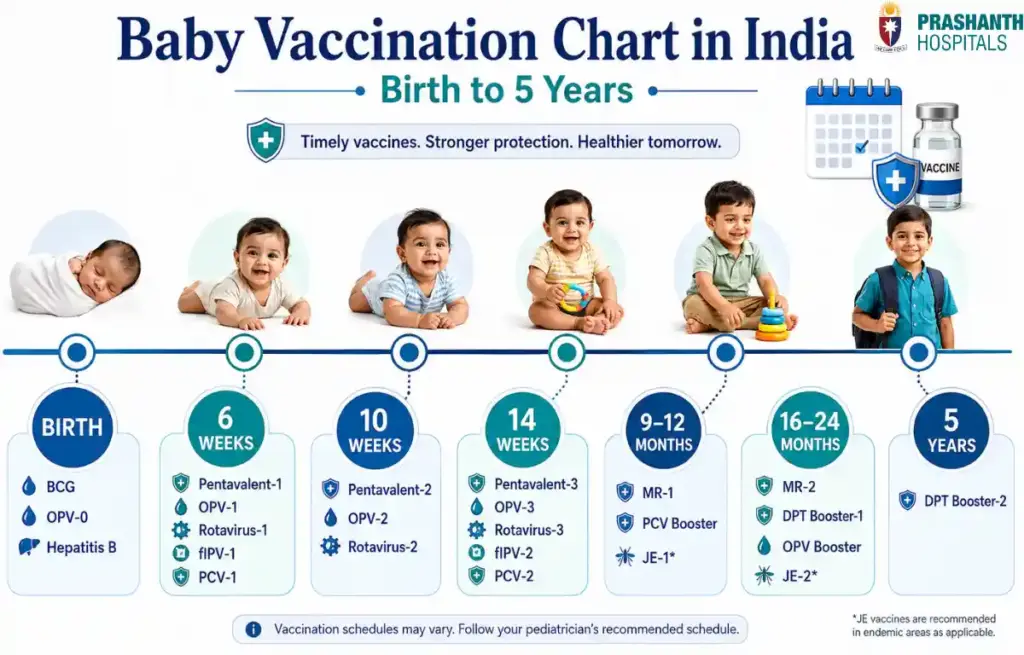
Complete Baby Vaccination Chart in India (Birth to 5 Years)
| Baby’s Age | Common Vaccines | Protects Against | Notes |
| At Birth | BCG, OPV-0, Hepatitis B | Tuberculosis, Polio, Hepatitis B | Hepatitis B is ideally given within the first 24 hours |
| 6 Weeks | Pentavalent, OPV/IPV, Rotavirus, PCV* | Diphtheria, Pertussis, Tetanus, Hepatitis B, Hib disease, Polio, Rotavirus diarrhea, Pneumococcal infections | Start of the primary infant vaccination series |
| 10 Weeks | Second doses of scheduled vaccines | Reinforces protection against the same diseases | Timely follow-up matters for building immunity |
| 14 Weeks | Third doses of scheduled vaccines | Strengthens long-term immune response | Completes the primary series for several vaccines |
| 9–12 Months | Measles-Rubella (MR), PCV booster*, others as advised | Measles, Rubella, continued pneumococcal protection | Important milestone during the first year |
| 16–24 Months | Booster doses (DPT, OPV/IPV, MR, others as recommended) | Maintains immunity as the child grows | Boosters extend earlier protection |
| 5 Years | DPT Booster | Diphtheria, Pertussis, Tetanus | Supports long-term immunity through early childhood |
*Certain vaccines and timing may vary depending on whether your child follows the Government UIP schedule or the broader IAP recommendations.
Many vaccines repeat not because the first dose failed, but because each dose builds on the one before it. Completing the full schedule matters just as much as starting it.
Why Timing and Repeat Doses Matter
When a vaccine is given matters almost as much as which vaccine is given. Each dose is timed around when babies become vulnerable to a specific infection and when their immune system can build the strongest response. Delaying doses doesn’t necessarily make a vaccine useless, but it can leave your baby unprotected during a period when they need protection most.
Repeat doses exist because the immune system gets stronger with repeated exposure, similar to how practicing something builds skill over time. The first dose introduces the immune system to the disease, the next doses strengthen that response, and booster doses keep protection active as your child grows.
What If My Baby Misses a Vaccine?
Don’t panic, and don’t assume the opportunity is lost. Most missed vaccines can be caught up with an adjusted schedule rather than starting over completely.
If you realize a dose was missed:
- Check your child’s vaccination card to see exactly what was missed
- Contact your pediatrician as soon as possible, rather than waiting for the next routine visit
- Follow the catch-up schedule your doctor recommends
- Keep future appointments on track
A missed appointment is usually a reason to reschedule, not a reason to restart.
Common Side Effects After Vaccination
Mild side effects are common and are often a sign the immune system is responding. Most settle within a day or two.
| Side Effect | What to Expect |
| Mild fever | Low-grade, usually settles within a day or two |
| Pain or swelling at the injection site | Mild redness or tenderness, improves within days |
| Fussiness | Some babies cry more or feel clingier for a short time |
| Sleepiness | Extra sleep for a day is common and not concerning |
| Reduced appetite | Some babies feed a little less for a brief period |
When to Seek Medical Attention
Serious reactions are uncommon, but contact your pediatrician or seek immediate care if your baby has:
- A very high or persistent fever
- Difficulty breathing, or swelling of the face or lips
- Continuous inconsolable crying lasting several hours
- Severe drowsiness or difficulty waking
- Seizures
- A widespread rash or signs of a severe allergic reaction
These reactions are rare, and for the vast majority of children, the benefits of vaccination far outweigh the risks.
Keeping Track of Your Baby’s Vaccination Record
A few simple habits go a long way:
- Bring the vaccination card to every pediatric visit, even for unrelated concerns
- Keep both a physical and digital copy
- Set a reminder a few days before the next due vaccine
- Ask your pediatrician for the next due date before you leave
If you ever lose the card, the hospital or clinic that gave earlier doses can usually help reconstruct the record from their files.
Getting Support at Prashanth Hospitals
If you have questions about your baby’s schedule, a missed dose, or which additional vaccines might be right for your child, a pediatric consultation can help. At Prashanth Hospitals, pediatric visits typically include a review of your baby’s vaccination history, guidance on catch-up scheduling if needed, and answers to any questions about the UIP or IAP schedules.
Conclusion
The vaccination schedule may look long at first, but every dose has a purpose. From birth through the early years, each vaccine helps your baby’s immune system build protection during the time they’re most vulnerable. Keeping track of the schedule and following up on time is one of the most valuable things you can do for your child’s health.