A period that suddenly becomes unpredictable. Acne that refuses to settle. More facial hair than usual. Difficulty getting pregnant.
These changes can make a woman wonder whether she has PCOD or PCOS, especially when the two terms are used as though they mean the same thing.
The confusion is understandable because their symptoms can overlap. But medically, PCOD and PCOS are not simply two names for the same diagnosis. PCOS, or polycystic ovary syndrome, is a recognised hormonal condition with reproductive and metabolic implications. PCOD is a term commonly used in India and some other settings, but it is not a separate, equivalent syndrome in current international PCOS guidelines.
So rather than asking which one is worse, it is more useful to understand the PCOD vs PCOS differences, what the terms mean, which symptoms matter, how PCOS is diagnosed, and what treatment may involve.
PCOD and PCOS: Why the Terms Get Confused
Both terms are commonly associated with irregular periods, changes in ovulation, acne, excess hair growth, and fertility concerns. That overlap makes it easy to assume that PCOD and PCOS are interchangeable.
There is, however, an important distinction.
PCOS is a syndrome, a collection of reproductive, hormonal, and metabolic features that may occur together. Diagnosis is based on the overall clinical picture rather than on the appearance of the ovaries alone.
PCOD is often used to describe a pattern of ovarian or hormonal dysfunction, but the term does not correspond to a separate equivalent diagnosis in current international guidelines.
The practical takeaway
If someone says they have PCOD, the most useful next step is not to assume what that label means. A medical evaluation can clarify whether they meet the diagnostic criteria for PCOS, or whether another condition is responsible for the symptoms.
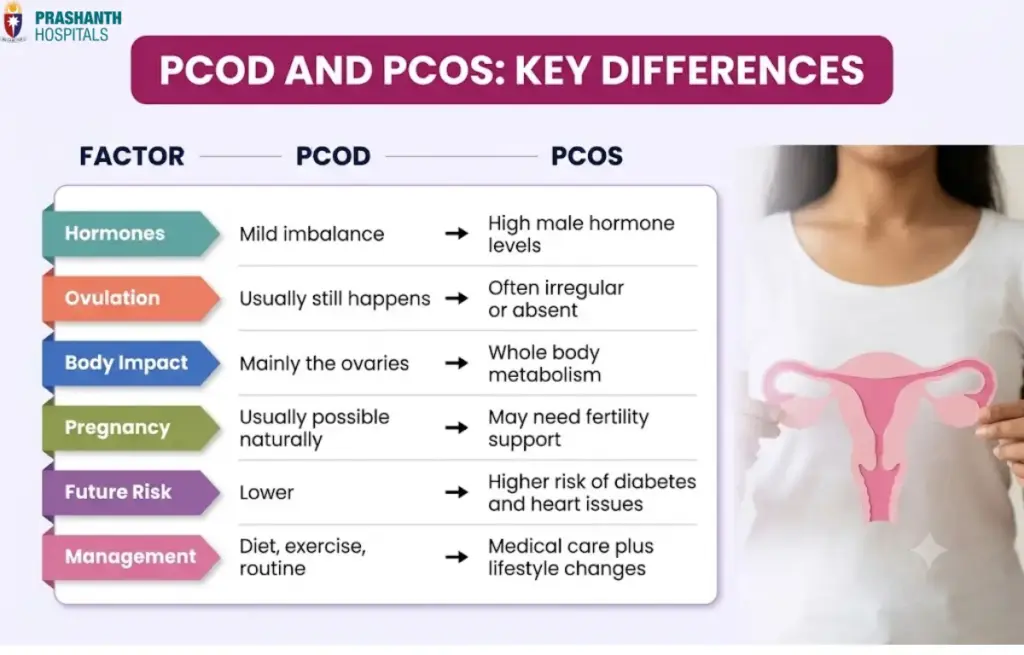
PCOD vs PCOS: What is Actually Different?
| Feature | PCOD | PCOS |
| What the term means | Commonly used to describe certain ovarian or hormonal patterns | A recognised hormonal and metabolic syndrome |
| Ovulation | May be irregular | Ovulatory dysfunction is common |
| Periods | May become irregular | Irregular or infrequent periods are common |
| Androgen-related symptoms | May occur | May include acne, excess hair growth, or scalp hair thinning |
| Metabolic concerns | May or may not be present | Metabolic health is an important part of assessment |
| Ovarian appearance | May be described as polycystic | Polycystic ovarian morphology may be one diagnostic feature |
| Diagnosis | Not a separate equivalent category in current international guidelines | Requires assessment against established diagnostic criteria |
| Fertility | Depends on whether ovulation is affected | Irregular ovulation can make conception more difficult |
The important point is that PCOS is not diagnosed simply because an ultrasound shows multiple small follicles. The findings need to be interpreted alongside symptoms, menstrual and ovulatory history, hormone-related features, and other relevant investigations.
What Symptoms Might You Actually Notice?
The symptoms of PCOS can vary considerably from one woman to another. Some may notice changes in their periods first, while others may be more troubled by acne, unwanted hair growth, or difficulty conceiving.
Changes in periods and ovulation
Irregular periods are one of the most common reasons women seek evaluation. Periods may become:
- Less frequent or unpredictable
- Separated by long gaps
- Absent for several months
- Difficult to track because ovulation is irregular
However, irregular periods do not automatically mean PCOS. Stress, thyroid disorders, changes in weight, excessive exercise, pregnancy, and several other conditions can affect the menstrual cycle.
Skin and hair changes
Higher androgen activity can contribute to:
- Excess facial or body hair
- Persistent acne
- Oily skin
- Scalp hair thinning in some women
The combination and severity of these symptoms can differ significantly between individuals.
Weight and metabolic changes
Some women with PCOS experience weight gain or difficulty managing weight, but PCOS is not limited to women who are overweight.
Insulin resistance may occur and can contribute to metabolic health concerns. At the same time, a woman can have PCOS without obvious signs of insulin resistance.
Fertility difficulties
When ovulation does not happen regularly, conception can take longer. PCOS is a common cause of ovulatory infertility, but a PCOS diagnosis does not mean that pregnancy is impossible.
One symptom does not tell the whole story
This is why self diagnosis can be misleading. A woman may have irregular periods without having PCOS. Another may have PCOS without excess hair growth or significant weight changes. The pattern matters more than any single symptom.
PCOS is About More Than the Ovaries
The word polycystic can make the condition sound as though the ovaries are the entire problem. They are not.
PCOS can involve an interaction between ovulation, androgen hormones, and metabolic health. These factors can influence menstrual cycles, fertility, skin and hair changes, and longer term health risks.
Clinical insight
Having polycystic appearing ovaries does not automatically mean you have PCOS. Some women may have this ovarian appearance without meeting the criteria for the syndrome. Conversely, not every woman with PCOS needs to have this appearance on an ultrasound.
That is why an ultrasound report should be understood in context rather than treated as a diagnosis by itself.
How do Doctors Diagnose PCOS?
There is no single test that confirms PCOS. For adults, current international guidance, known as the Rotterdam Criteria, looks at three major features:
- Clinical or biochemical hyperandrogenism, such as signs of increased androgen activity or elevated androgen levels.
- Ovulatory dysfunction, often reflected by irregular or infrequent menstrual cycles.
- Polycystic ovarian morphology on ultrasound, or an elevated Anti-Mullerian Hormone, or AMH, level. AMH is a blood test that can be used as an alternative to an ultrasound for this specific feature, not as an extra requirement on top of it.
In adults, having two of these three features can support a diagnosis of PCOS, but only after other conditions that can cause similar symptoms have been considered and ruled out. This is an important step, since several other conditions can look like PCOS on the surface. A doctor will typically check for thyroid dysfunction, high prolactin levels, a rare adrenal condition called non classic congenital adrenal hyperplasia, and in some cases Cushing’s syndrome, before confirming a PCOS diagnosis.
A doctor may therefore consider:
- Menstrual and ovulation history
- Acne, excess hair growth, and other androgen-related symptoms
- Relevant hormone testing, including thyroid and prolactin levels
- Blood glucose and metabolic assessment
- Physical examination
- Ultrasound or AMH testing when appropriate
Diagnosis in adolescents
The situation is different for adolescents, because normal pubertal changes, including a naturally higher number of ovarian follicles, can resemble some features of PCOS. To avoid over-diagnosis, adolescents generally need to show both irregular menstrual cycles and clear clinical or biochemical hyperandrogenism, after other causes have been excluded. Ultrasound and AMH testing are usually not recommended for diagnosing PCOS in adolescents, particularly within eight years of a first period, since follicle counts and AMH levels are naturally higher at that stage of life.
This also explains why a scan saying polycystic ovaries is not the same as being diagnosed with PCOS, in either adults or teenagers.
What Does PCOS Mean for Fertility?
For many women, fertility is the concern behind the search for PCOD vs PCOS.
PCOS can affect fertility primarily because ovulation may not occur regularly. If an egg is not released consistently, the chances of conception during a given cycle can decrease.
But irregular ovulation is not the same as permanent infertility.
When pregnancy is desired, treatment is individualised and may focus on improving or inducing ovulation, depending on what the fertility assessment shows. This may involve lifestyle measures, medicines, or other fertility treatments.
A fertility evaluation should also consider factors beyond PCOS, including:
- Age
- Ovulation
- Sperm health
- Fallopian tube factors
- Other reproductive conditions
So a PCOS diagnosis should be viewed as one part of the fertility picture, not as a prediction of whether a woman can become pregnant.
Long-Term Health Risks Linked to PCOS
PCOS is not only about periods, skin, or fertility. International guidelines recognise it as a condition with wider health implications, which is why ongoing monitoring matters even when periods and skin symptoms are under control.
Some of the longer term concerns associated with PCOS include:
- Type 2 diabetes and impaired glucose regulation. Insulin resistance is common in PCOS and can raise the risk of developing diabetes over time, so periodic glucose testing is often recommended.
- Cardiovascular risk factors, such as changes in cholesterol levels and blood pressure, which are worth monitoring as part of routine care.
- Sleep apnea, a condition where breathing repeatedly stops and starts during sleep, which occurs more often in women with PCOS than in the general population.
- Psychological wellbeing. Anxiety and low mood are more common among women with PCOS, and many current guidelines recommend that doctors screen for this as part of ongoing care, not treat it as separate from the physical symptoms.
- Pregnancy-related risks, such as a higher chance of gestational diabetes, when relevant to the individual.
None of this means every woman with PCOS will develop these conditions. It means these are the areas a doctor will typically keep an eye on over time, alongside the reproductive symptoms that usually bring someone in for evaluation in the first place.
How is PCOS Managed?
PCOS management is not about treating an ultrasound finding. It is about addressing the problems that are actually affecting the individual.
| Main concern | Management may focus on |
| Irregular periods | Cycle regulation and protection of the uterine lining where appropriate |
| Acne or excess hair | Symptom-specific and hormonal treatment where appropriate |
| Metabolic concerns | Nutrition, physical activity, and medical management when indicated |
| Insulin resistance | Lifestyle measures and medication when clinically appropriate |
| Difficulty conceiving | Assessment and treatment aimed at restoring or supporting ovulation |
| Long-term health | Periodic monitoring of glycaemic status, cardiovascular risk, and psychological wellbeing |
Cycle regulation deserves a bit more explanation, since it is often misunderstood. When periods are absent or very infrequent for a long time, the lining of the uterus can be exposed to estrogen without the usual monthly shedding. Over time, this can raise the risk of the uterine lining thickening abnormally, a condition called endometrial hyperplasia, which in rare cases can progress further. This is why doctors often recommend a way to bring on a regular withdrawal bleed, such as progestin therapy or a birth control pill, even for women who are not trying to conceive. It is a protective step for the uterine lining, not just a convenience for managing periods.
Metabolic assessment usually means checking glycaemic status, though the specific test, such as a fasting glucose or an oral glucose tolerance test, depends on individual risk factors and clinical judgement.
Lifestyle measures are an important part of care, particularly for metabolic health. For women who are overweight, appropriate weight management may improve some menstrual and metabolic outcomes, but PCOS should never be reduced to simply a weight problem.
Treatment also depends on whether pregnancy is currently desired. For example, someone primarily concerned about irregular periods may need a different approach from someone trying to conceive. A woman troubled by acne or excess hair may need another combination of treatments.
The goal is personalised management, not a one size fits all PCOS prescription.
When Should You Get Evaluated?
It is worth speaking with a doctor when menstrual or hormonal changes are persistent, rather than assuming they are simply normal.
Consider an evaluation if you have:
- Repeatedly irregular or very infrequent periods
- Periods that stop for several months without an explanation
- New or increasing facial or body hair
- Persistent or significant acne
- Unexplained metabolic or weight-related concerns
- Difficulty becoming pregnant
- An ultrasound report describing polycystic ovaries
- Symptoms that are changing or affecting your wellbeing
Persistent menstrual irregularity deserves attention because PCOS is only one possible explanation. Thyroid disorders, elevated prolactin, hypothalamic causes, pregnancy, and other hormonal or reproductive conditions may produce similar patterns.
The purpose of an evaluation is not simply to put a label on the symptoms. It is to find the reason behind them.
Understanding the Difference Makes the Next Step Clearer
PCOD and PCOS are often treated as though they are two versions of the same condition, but that is an oversimplification.
PCOS is a recognised syndrome involving reproductive, hormonal, and potentially metabolic features. PCOD is a commonly used term, particularly in India, but it is not a separate equivalent syndrome in current international diagnostic guidance.
If your periods have become irregular, you are experiencing acne or excess hair growth, or you are having difficulty conceiving, there is no need to decide for yourself whether the problem is PCOD or PCOS.
A proper evaluation can look beyond one symptom or one ultrasound finding and identify what is actually happening.
At Prashanth Hospitals, women can seek medical evaluation for menstrual, hormonal, and reproductive health concerns, with care tailored to their symptoms, clinical findings, and individual health goals.
And perhaps the most reassuring point is this: having PCOS does not mean giving up on a healthy future or future pregnancy. With appropriate evaluation and personalised management, many of its symptoms and associated health concerns can be addressed.
The goal is not simply to name the condition. It is to understand your body, identify what needs attention, and choose care that fits your needs.
Check out 7-Day PCOS Diet Plan for Hormone Balance.