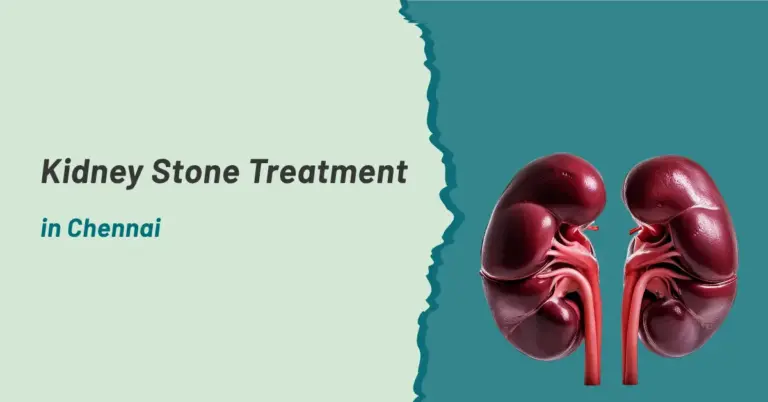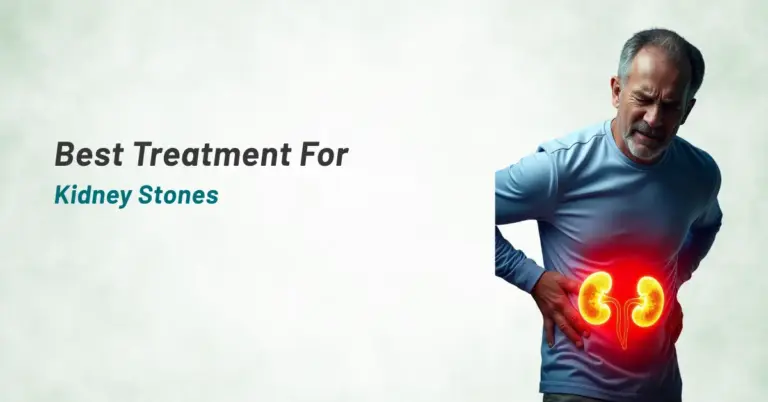
Kidney stones can cause sudden, severe pain that disrupts daily life without warning. Fortunately, modern laser technology now allows most stones, whether located in the kidneys, the urinary bladder, or the ureter (the tube connecting the kidney to the bladder), to be treated through a minimally invasive endoscopic procedure, without the need for open surgery.
What are Kidney Stones and Who Does it Affect?
Kidney stones are more common in adults between 30 and 60 years, though they can affect both men and women of any age. They form when minerals and salts such as calcium oxalate, uric acid, cystine, or struvite crystallise in the urinary tract over time. Usually, small deposits pass out of the body through urine without causing any issues. However, larger stones cause serious blockages and severe pain that require medical treatment.
Who Needs Kidney Stone Laser Treatment?
Not every kidney stone requires laser treatment. Small stones, typically under 5mm, often pass on their own with sufficient hydration and pain management. Laser treatment is recommended when:
- The stone is too large to pass naturally (usually above 6–7mm)
- The stone is causing a persistent blockage in the ureter or kidney
- The patient is experiencing recurring or severe pain that is unmanageable
- There is an associated urinary tract infection caused by the stone
- The stone has not passed after a reasonable period of conservative treatment
- The stone is located in a position that makes natural passage unlikely
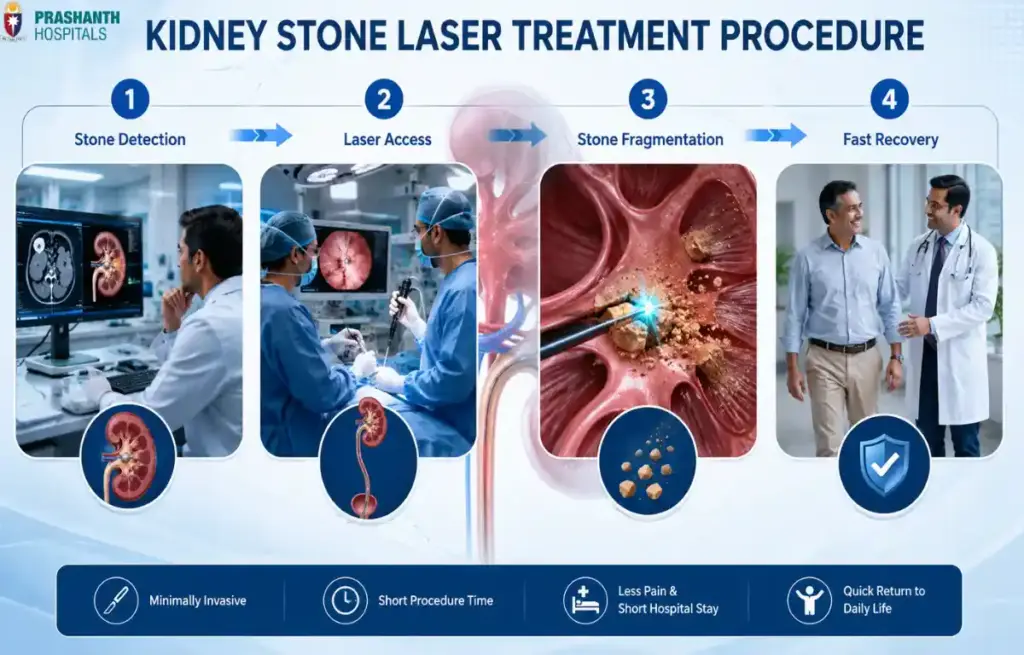
Your urologist at Prashanth Hospitals will evaluate the size, location, and composition of the stone using imaging. A non-contrast CT KUB is often the most accurate test, before recommending laser lithotripsy.
How Does Kidney Stone Laser Treatment Work?
Laser technology for treating kidney stones has been in existence for quite some time, but advances in flexible ureteroscopy have made it significantly more precise and effective. During the procedure, an ultra-thin laser fiber (about 0.2 millimeters) is passed through a high-definition flexible scope that is introduced through the urethra. This allows the fiber to reach the exact location of the stone, whether it is in the kidney, urinary bladder, or ureter, and deliver focused laser pulses.
The laser emits short pulses of infrared light capable of fragmenting most kidney stones into smaller pieces that can pass through urine naturally. Being a minimally invasive endoscopic procedure, most patients recover quickly with a low risk of complications.
The Laser Procedure
The laser procedure is known as laser lithotripsy. A tiny camera built into the scope is used to guide the laser fiber directly to the kidney stone. Intense pulses of laser energy then break the stone down into fine fragments. The procedure typically lasts between 10 minutes and 1 hour, depending on the size and location of the stone.
Unlike older treatment approaches, the modern laser system allows the beam to precisely target the stone and minimise damage to surrounding tissues. Most patients are discharged the same day or within 24 hours of the procedure.
Kidney Stone Laser Treatment Cost in India
The cost of kidney stone laser treatment in India typically ranges between ₹40,000 and ₹1,20,000 depending on a number of factors. This is significantly more affordable compared to Western countries, where the same procedure can cost anywhere between $3,000 and $8,000 (approximately ₹2.5 lakh to ₹6.5 lakh).
At Prashanth Hospitals, laser treatment for kidney stones is priced competitively and many procedures are covered under standard health insurance plans and cashless schemes. Patients are advised to check with the billing team for the latest package pricing specific to their case and branch location.
Factors that Affect the Kidney Stone Laser Treatment Cost
The overall cost can vary based on several key factors:
- Stone size and number — A single small stone costs less to treat than multiple large stones
- Location of the stone — Stones lodged deeper in the kidney or ureter require more complex procedures
- Type of laser used — Holmium laser and newer thulium fibre lasers differ in cost
- Hospital room type — General ward, semi-private, or private room choices affect the overall bill
- Anaesthesia type — Local vs. general anaesthesia has different cost implications
- Stent placement — If a ureteral stent is placed after the procedure, a follow-up visit for removal will also be needed, which adds to the overall cost
- Diagnostic tests — Pre-operative scans, blood tests, and urine cultures are billed separately
- Insurance coverage — The out-of-pocket amount varies depending on your insurer and policy
It is always advisable to get a detailed cost estimate from the hospital before the procedure and confirm what is included in the quoted price.
Kidney Stone Laser Treatment Side Effects
Laser lithotripsy has a high stone-clearance success rate, particularly for small to medium-sized ureteric and kidney stones. However, like any medical procedure, it may be associated with some temporary side effects:
- Mild burning or discomfort during urination — Very common in the first few days after the procedure as stone fragments pass out
- Blood in urine (haematuria) — A pink or reddish tinge in urine is normal for 1–3 days post-procedure and resolves on its own
- Frequent urge to urinate — The bladder may be mildly irritated following the scope insertion
- Mild abdominal or flank pain — Usually manageable with prescribed pain medication
- Ureteral stent discomfort — If a stent is placed to aid fragment passage, it can cause a sensation of urgency or mild pelvic discomfort until it is removed (typically within 1–2 weeks)
Serious complications such as infection, injury to the ureter, or incomplete stone clearance are rare but possible. Your doctor will provide specific post-procedure care instructions to minimise these risks. If you experience high fever, severe pain, or no urine output after the procedure, contact your urologist immediately, as these are signs that need prompt medical attention.
Laser Treatment vs. Other Kidney Stone Removal Methods
There are several treatment options for kidney stones, and the right choice depends on stone size, location, and your overall health.
| Treatment | How It Works | Best For |
| Laser Lithotripsy (URSL) | Laser fiber via flexible scope through urethra | Most ureteric and kidney stones (small to large, typically under 2cm) |
| ESWL (Shockwave) | Sound waves from outside the body break stones | Smaller kidney stones |
| PCNL (Keyhole Surgery) | Small incision in the back to access the kidney | Very large or complex stones (>2cm) |
| Open Surgery | Traditional surgical approach | Rarely needed today |
Laser lithotripsy is preferred for most patients because it is minimally invasive, highly precise, and allows a rapid recovery. ESWL involves no scope entry but may not be effective for harder stones or stones in certain positions. For very large stones such as staghorn calculi, PCNL remains the gold standard.
The Follow Up and Preventing Kidney Stone Recurrence
The flushed-out stone fragments are analysed in the laboratory, and doctors then advise on lifestyle changes and diet to prevent recurrence. The simplest step is staying well hydrated. Aim for enough fluid intake to produce around 2 to 2.5 litres of urine daily. (Note: patients with heart disease or chronic kidney disease should follow their doctor’s specific fluid recommendations.)
Based on the type of stone, some dietary adjustments will be required:
- Calcium oxalate stones — Reduce oxalate-rich foods like spinach, nuts, and chocolate; maintain adequate calcium intake
- Uric acid stones — Limit red meat, shellfish, and alcohol; stay well hydrated
- Calcium phosphate stones — Reduce sodium intake and animal protein
- Struvite stones — Usually linked to urinary tract infections; treating the underlying infection is key to prevention
Medications may also be prescribed depending on the stone type to reduce recurrence risk. Follow-up imaging is typically scheduled at 3 to 6 months after the procedure to confirm complete stone clearance.
Why Choose Prashanth Hospitals for Kidney Stone Laser Treatment?
Prashanth HospitalsPrashanth Hospitals is a NABH-accredited multi-specialty hospital with dedicated Nephrology and Urology departments across multiple locations in Chennai. The urology team has extensive experience in performing laser lithotripsy procedures using advanced holmium laser technology.
Key reasons patients choose Prashanth Hospitals:
- Experienced team of urologists and nephrologists
- Advanced laser equipment with precise stone-targeting capability
- Cashless insurance facility with most major insurers
- Transparent pricing and pre-procedure cost counselling
- Same-day discharge in most cases
- Comprehensive post-procedure follow-up care
If you are experiencing symptoms of kidney stones or have been advised laser treatment, book an appointment with our Nephrology and Urology team at your nearest Prashanth Hospitals branch.