If you have just been told you have a kidney stone, the first thing you want to know is what happens next. Will it pass on its own? Do you need surgery? What is the least painful option?
The honest answer is that it depends on the stone. The size, type, and location of the stone decide everything. Some kidney stones pass in days with just water and rest. Others need laser treatment or surgery. Knowing which category your stone falls into takes the fear out of the situation.
This guide walks you through every treatment option clearly, including when a stent is used and why, so you know what to expect at every step.
What is a Kidney Stone?
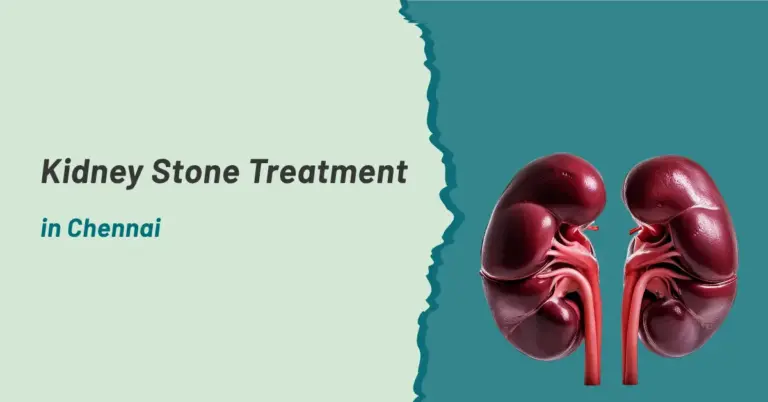
Your kidneys filter waste from your blood and pass it out through urine. When certain minerals in your urine build up too much, they can harden into small deposits inside the kidney. These are kidney stones.
Stones can be as tiny as a grain of sand or as large as a marble. Small ones often pass out on their own. Larger ones need a doctor’s help.
The most common types are calcium oxalate stones, uric acid stones, struvite stones, and cystine stones. Knowing the type matters because some can be dissolved with medicine, while others cannot.
Signs You May have a Kidney Stone
Many people have no symptoms at all if the stone is small and sitting still inside the kidney. Symptoms usually start when the stone begins to move toward the ureter, which is the narrow tube that connects the kidney to the bladder.
Common signs include sharp pain on one side of the back or lower abdomen, pain that comes in waves and may spread toward the groin, a burning feeling while urinating, blood in the urine (which may appear pink, red, or brown), feeling the urge to urinate more often than usual, nausea or vomiting, and fever or chills if an infection has developed alongside the stone.
Kidney stone pain is often sudden and severe. If you have these symptoms, see a doctor the same day rather than waiting.
How Doctors Diagnose Kidney Stones
Your doctor will ask about your symptoms and order a few tests. A urine test checks for blood or signs of infection. A blood test looks at kidney function and mineral levels. An imaging test, usually an ultrasound or CT scan, confirms whether a stone is present, shows where it is, and measures its size.
The size and location of the stone are the two most important things that guide treatment decisions.
Which Treatment is Right for You? A Stone Size Guide
This is the question most patients ask first. Here is a simple guide based on stone size.
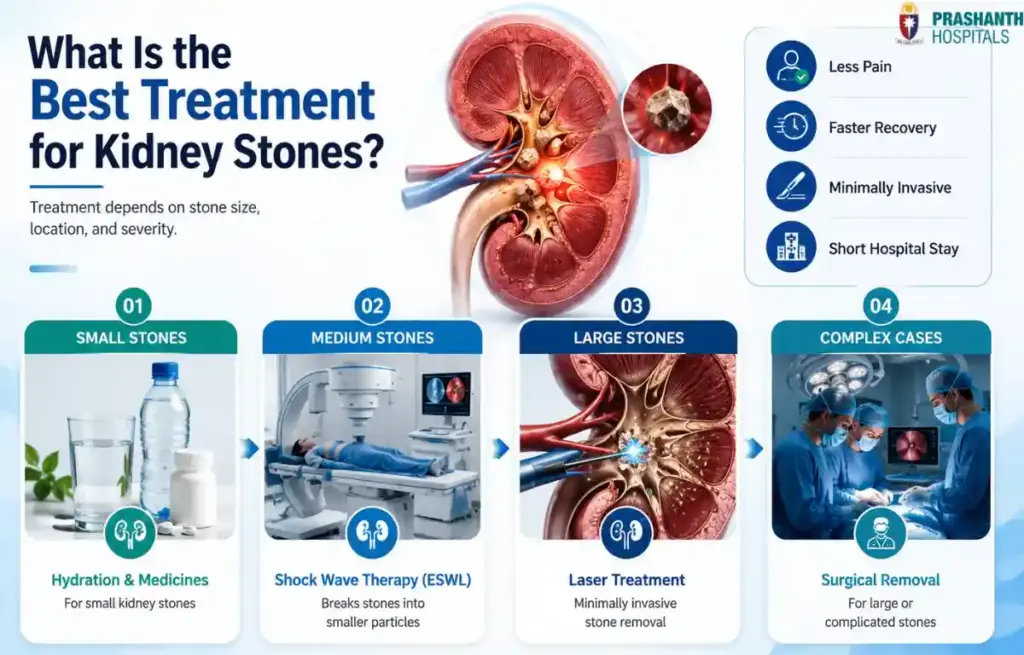
Stones smaller than 5mm These are small enough to pass on their own in most cases. Your doctor will ask you to drink plenty of fluids, take a pain reliever if needed, and wait. Many stones this size pass within a few weeks.
Stones between 5mm and 10mm These may or may not pass without help. Your doctor may prescribe a medication called an alpha-blocker (such as tamsulosin) that helps relax the ureter and improve stone passage. Shock wave treatment (ESWL) is also used for stones in this range.
Stones between 10mm and 20mm These rarely pass on their own and usually need a procedure. Laser treatment (ureteroscopy or RIRS) is the most effective approach for stones in this size range.
Stones larger than 20mm Stones this large almost always require a procedure called PCNL (percutaneous nephrolithotomy). This is done through a small cut in the back.
Medications Used in Kidney Stone Treatment
Not every kidney stone needs a procedure. Medicines are a real and important part of treatment, especially for smaller stones and for preventing new ones from forming.
Alpha-blockers like tamsulosin relax the ureter muscles so stones can pass more easily. They are usually prescribed for stones sitting in the lower ureter.
Potassium citrate is used for uric acid stones. It makes the urine less acidic, which can actually dissolve this type of stone over time.
Pain relief medicines such as ibuprofen or paracetamol help manage discomfort while waiting for a stone to pass on its own.
Antibiotics are prescribed when a urinary tract infection is present alongside the stone, which is an important situation to treat quickly.
Extracorporeal Shock Wave Lithotripsy (ESWL)
ESWL breaks kidney stones from outside the body without any cuts or instruments going inside. High-energy sound waves are focused on the stone, breaking it into small fragments that pass out through the urine over the next few weeks.
It is recommended for stones smaller than 2 cm in the kidney or upper ureter. The procedure is done under light sedation and takes about 45 to 60 minutes. Most patients go home the same day.
ESWL works best when the stone is in a position the sound waves can reach easily. Very hard stones or stones in certain locations may not respond as well.
Recovery is straightforward. Most people return to normal activities within 1 to 2 days. Some blood in the urine and mild soreness is expected for a short time after the procedure. The machine used to deliver the sound waves is called a lithotripter.
Ureteroscopy and Laser Treatment (URSL)
Ureteroscopy is one of the most commonly performed kidney stone procedures today. The doctor passes a thin instrument called a ureteroscope through the urethra and bladder into the ureter. No skin incisions are made.
Once the stone is located, a laser breaks it into fine fragments or dust. These fragments are either removed during the procedure or pass out naturally over the next few days.
This treatment is very effective for stones in the ureter and smaller stones inside the kidney. Hospital stay is less than 24 hours in most cases. Most patients return to desk work within 2 to 3 days.
Retrograde Intrarenal Surgery (RIRS)
RIRS is a newer procedure that uses a fully flexible ureteroscope. Unlike the semi-rigid instrument used in standard ureteroscopy, this flexible scope can bend and navigate into every part of the kidney, including areas deep inside that older instruments could not reach.
A laser is used to reduce the stone to fine dust. Because of how far the flexible scope can travel, RIRS can treat stones in almost any location inside the kidney without any incision.
It is particularly suited for stones between 10mm and 20mm and for patients who want a procedure that leaves no cuts. Recovery is faster than PCNL. Most patients go home the next day.
Percutaneous Nephrolithotomy (PCNL)
PCNL is the preferred treatment for large kidney stones above 2 cm, or for stones that are too hard to break with laser or sound waves.
The surgeon makes a small cut, about 1 cm, in the back and creates a direct channel into the kidney. Through this channel, a nephroscope is used to either remove the stone whole or break it up and clear it in pieces.
PCNL is done under general anaesthesia. Hospital stay is typically 2 to 3 days. Most patients return to normal activities within 1 to 2 weeks depending on their job and physical condition.
Despite requiring a small incision, PCNL can clear even the largest stones in a single procedure, which is why it remains the standard for complex cases.
Why is a Stent Used in Kidney Stone Treatment?
Many patients are caught off guard when their doctor mentions placing a stent. This is one of the most commonly asked questions about kidney stone treatment, so here is a clear explanation.
A ureteral stent is a thin, soft, hollow tube roughly 25 to 30 cm long. It has a small curl at each end to keep it in position. One end sits in the kidney and the other in the bladder, and the tube runs through the ureter between them.
When is a stent placed?
There are several situations where a stent is needed. If a stone is blocking the ureter and urine cannot flow properly, a stent is placed to drain urine and protect the kidney from pressure damage. After laser treatment or ESWL, the ureter may swell slightly. A stent keeps it open so urine continues to drain normally during healing. When stone fragments need to pass after a procedure, a stent keeps the path open and reduces the risk of another blockage forming. If there is an infection alongside a blockage, a stent is placed immediately so the kidney can drain while antibiotics work.
What does a stent feel like?
Most patients notice a mild pressure in the lower abdomen or a more frequent urge to urinate. Some people feel a dull ache in the back, particularly after physical activity. These are temporary feelings and improve as the ureter heals.
How long does the stent stay in?
In most cases, the stent stays in for 1 to 2 weeks. Your doctor will tell you the exact timing based on your procedure and recovery.
How is the stent removed?
Stent removal is done as an outpatient procedure. The doctor passes a thin instrument called a cystoscope through the urethra into the bladder and gently pulls the stent out. The whole thing takes a few minutes. No hospital stay is needed.
Open Surgery for Kidney Stones
Open surgery is very rarely needed today. Most stones, even large ones, can be treated with PCNL or laser procedures. However, open surgery may be considered when a stone is extremely large and cannot be cleared with PCNL, when the kidney has an unusual shape or structure that prevents other approaches, or when multiple previous procedures have not been successful.
Open surgery involves an incision in the back or side to access the kidney directly. Recovery takes approximately 4 to 6 weeks.
Kidney Stone Treatment in India
India has become a trusted destination for kidney stone care, not just for its costs but for the quality of treatment available. Hospitals across major cities offer the full range of procedures, from ESWL to RIRS to PCNL, supported by experienced urologists and nephrologists.
Around 12% of the Indian population is affected by kidney stones, making it one of the most commonly treated urological conditions in the country. As a result, urologists in India have significant hands-on experience with all stone sizes and types.
Procedure costs in India are considerably lower than in Western countries, without compromising on technology, skill, or outcomes. For patients from smaller towns, neighbouring countries, or those seeking affordable specialist care, India offers practical access to advanced kidney stone treatment.
Recovery After Kidney Stone Treatment
Recovery time depends on which treatment you had.
After passing a small stone on your own or having ESWL, most people return to normal activity within 1 to 3 days. Some blood in the urine for a short time is normal.
After ureteroscopy or RIRS, most patients go home the next day and can return to desk work within 2 to 3 days. Physical work should wait about a week.
After PCNL, expect 2 to 3 days in hospital and roughly 1 to 2 weeks before returning to work. Full recovery from any tenderness around the incision takes 3 to 4 weeks.
Drink plenty of water throughout your recovery to help flush out any remaining stone fragments. Follow your doctor’s guidance on diet and activity carefully.
Can Kidney Stones Come Back?
Yes, they can. Around half of people who have had one kidney stone will develop another within 5 to 10 years without preventive measures. The good news is that recurrence is highly preventable.
How to Prevent Kidney Stones
Drink enough water through the day so your urine stays pale yellow or clear. This is the single most effective prevention step.
Limit salt in your food. High sodium levels increase the amount of calcium that passes into the urine, which raises the risk of stone formation.
Eat meat, fish, and eggs in moderation. Excess animal protein increases uric acid and calcium in the urine.
Do not cut out dairy or calcium from your diet. This is a common mistake. Dietary calcium actually helps by binding to oxalate in the gut before it reaches the kidneys.
Avoid very large amounts of high-oxalate foods like spinach, nuts, and beetroot if you have a history of calcium oxalate stones.
After treatment, have your stone tested if possible. Knowing the exact stone type allows your doctor to recommend the most targeted prevention plan for you.
Why Choose Prashanth Hospitals for Kidney Stone Treatment
At Prashanth Hospitals, our nephrology and urology team handles kidney stone cases at every level of complexity, from small stones managed with medication to large or multiple stones requiring PCNL or staged procedures.
We use modern imaging to accurately assess each stone before deciding on treatment. Our team selects the approach that suits your stone size, type, location, and overall health. We offer ESWL, laser ureteroscopy, RIRS, PCNL, stent placement, and post-treatment follow-up all under one roof.
Our branches across Chennai, including Chetpet, Velachery, Kolathur, Tambaram, Ambattur, and Padur, make specialist kidney care accessible wherever you are in the city.