Breastfeeding vs formula feeding is one of the first big questions new parents face. Many mothers worry about choosing wrongly, especially when family, friends and the internet all say different things. Breast milk is the best first food for a baby, and formula is a safe option when breastfeeding is not possible or not enough. What matters most is that the baby is well fed, growing well and cared for with love. This guide explains both choices clearly so families can decide with confidence and with the right medical advice.
- Breast milk is the recommended first choice. The WHO and the Indian Academy of Pediatrics advise breast milk alone for the first 6 months.
- Formula is a safe option when breastfeeding is not possible or does not fully meet the baby’s needs. It should be used on the advice of a doctor or health worker.
- Many families use both, which is called mixed feeding.
- The right plan is one the family can keep up, made with guidance from a doctor.
What is the Difference Between Breast Milk and Formula?
Breast milk is made by the mother’s body, and it changes to suit the baby. In the first few days, the breasts make colostrum. This is a thick, yellow milk rich in antibodies, which are proteins that help fight germs. Over the following weeks, the milk changes as the baby grows. It can even change within a single feed and from day to night.
Infant formula is made in a factory, usually from cow’s milk that has been changed so a baby can digest it. It contains the main nutrients a baby needs, such as protein, fat, sugar, vitamins and minerals. Formula follows strict safety standards and supports healthy growth. However, it cannot copy the living cells, antibodies and other protective parts found in breast milk.
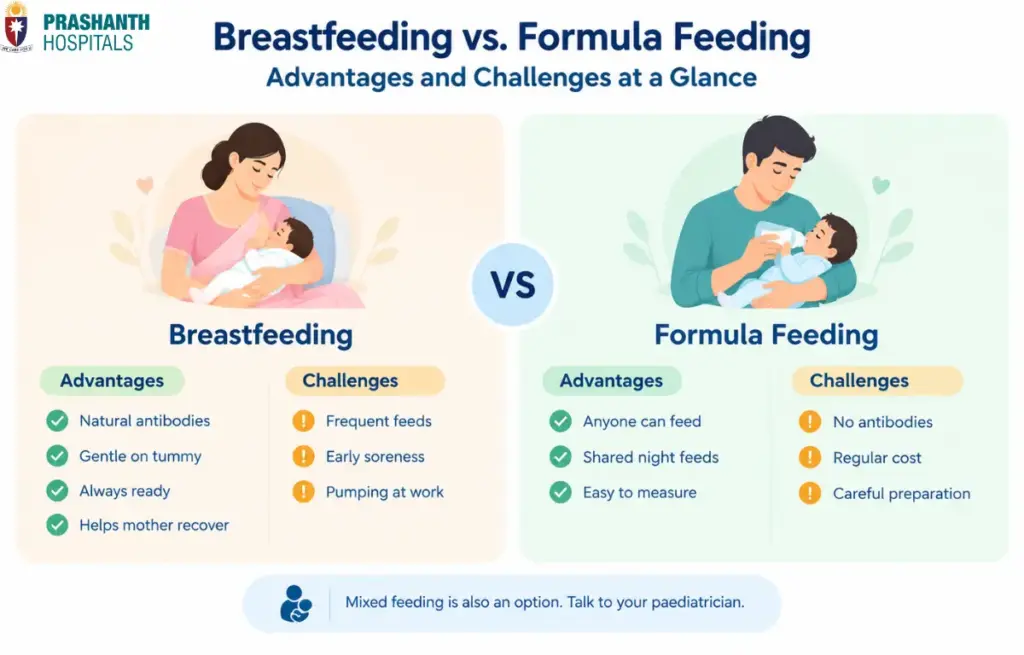
Breastfeeding vs Formula Feeding: Advantages and Disadvantages at a Glance
| Breastfeeding | Formula Feeding | |
|---|---|---|
| Main advantages | Antibodies that help protect against infections, usually gentle on the stomach, ready at any time, helps the mother recover after birth | Other caregivers can feed the baby, intake is easy to measure, night feeds can be shared |
| Main challenges | Early soreness, frequent feeds, pumping and storing milk when away from the baby, checking medicines | No antibodies, regular cost, careful cleaning, mixing and storage for every feed |
| Cost | Milk itself is free, though some mothers spend on pumps, storage bags or nursing bras | Ongoing cost of formula, bottles, teats and cleaning supplies |
| Preparation | None for direct feeds; pumped milk needs clean equipment and safe storage | Safe water heated to 70°C or above, sterilised bottles and exact measuring each time |
| Flexibility | Depends on work, support at home and access to pumping | Depends on access to safe water, supplies and time to prepare feeds |
Every family’s situation is different, so one option is not always easier than the other.
Advantages of Breastfeeding
Benefits for the Baby
Breast milk passes the mother’s antibodies to the baby. This helps lower the risk of common problems such as ear infections, chest infections and diarrhoea. Some studies suggest breastfed babies may also have a lower risk of asthma, eczema and obesity later in life.
Many babies find breast milk gentle on the stomach, and breastfed babies often have softer stools. Breast milk is also at the right temperature and ready whenever the baby is hungry.
Benefits for the Mother
Breastfeeding helps the womb shrink back to its normal size after delivery and can reduce bleeding. Over the long term, it is linked to a lower risk of breast cancer, ovarian cancer and type 2 diabetes. Many mothers also find that the closeness during feeds helps them bond with their baby.
Looking After the Mother’s Health
A breastfeeding mother needs enough food, fluids and rest. A balanced diet helps her stay strong, and a doctor can advise on any extra supplements. Starting breastfeeding soon after birth and feeding often also helps milk supply build up.
Disadvantages and Challenges of Breastfeeding
Breastfeeding is natural, but it does not always come easily. Knowing the common challenges helps mothers ask for help early.
- Pain in the early days: Some tenderness is common in the first week. A poor latch is a frequent cause, but pain can also come from infection, tongue tie in the baby or other problems. If pain is severe or does not settle, a doctor or lactation professional should check both mother and baby.
- Frequent feeds: Newborns often feed 8 to 12 times a day. This can be tiring, especially at night.
- Work and travel: Mothers returning to work need time, privacy and a clean place to pump and store milk.
- Medicines: Many common medicines are safe during breastfeeding, but some are not. A doctor or pharmacist can check each medicine and suggest a safe option if needed.
- Alcohol: Not drinking alcohol is the safest choice while breastfeeding. If a mother has a single drink, waiting at least 2 hours before breastfeeding lets alcohol levels in the milk fall. More drinks need a longer wait. Pumping and throwing away milk does not remove alcohol any faster.
- Worry about supply: Many mothers fear they are not making enough milk. Often supply is fine, but a doctor can check if there is a real concern. Simple steps can help, as explained in 6 Ways to Increase Breast Milk.
- When breastfeeding is not advised: In a few situations, such as certain infections, some medicines or rare conditions in the baby, a doctor may advise against breastfeeding.
Latch and Positioning Basics
A good latch makes feeding comfortable and helps the baby get enough milk. Signs of a good latch include:
- The baby’s mouth is wide open and covers more than just the nipple
- The chin touches the breast and the lips turn outwards
- Steady swallowing can be seen or heard
- Feeding does not hurt after the first few seconds
Hold the baby close, tummy to tummy, with the head and body in a straight line. Bring the baby to the breast, not the breast to the baby. Common positions are the cradle hold, the football hold under the arm and lying on your side. Ask a nurse, doctor or lactation professional to watch a feed before you leave the hospital. If the nipple hurts throughout a feed, break the suction gently with a clean finger and try again.
Breastfeeding After a C Section or With a Health Condition
After a C section: Most mothers can breastfeed soon after a C section. The side lying and football holds keep the baby away from the stitches. Milk may take a little longer to come in, so ask for help with positioning and feed often.
With a health condition or regular medicines: Conditions such as diabetes, thyroid problems or high blood pressure do not always stop breastfeeding, and many medicines are safe. Do not stop or change any medicine on your own. Ask your doctor to review your condition and each medicine, and to advise on feeding your baby.
Expressing and Storing Breast Milk
Mothers who return to work or are away from the baby can express milk by hand or with a pump. It helps to start a routine a few weeks before going back, and to express at the times you would normally feed.
- Wash your hands and use clean, dry containers.
- Label each container with the date and time.
- Room temperature: Up to 4 hours in a cool place.
- Fridge: Up to 4 days, at the back where it is coldest.
- Freezer: Best used within 6 months.
- Thawed milk: Keep it in the fridge and use it within 24 hours. Do not refreeze it.
- Warm milk by standing the container in warm water. Do not use a microwave or boil it.
- Throw away milk left in the bottle after a feed.
Advantages of Formula Feeding
- Shared feeding: Fathers, grandparents and other caregivers can feed the baby and bond during feeds.
- Shared night feeds: The mother may get longer stretches of rest when others help at night.
- Easy to measure: Parents can see how much milk the baby has taken.
- Fewer diet and medicine concerns: The mother does not need to plan her diet or medicines around feeds.
- A safe option when needed: For babies who cannot get enough breast milk, formula supports healthy growth.
Disadvantages and Challenges of Formula Feeding
- No antibodies: Formula does not contain the living cells and antibodies that help protect babies from infections.
- Ongoing cost: Formula, bottles, teats and cleaning supplies add up month after month.
- Careful preparation: Bottles must be cleaned and sterilised, and formula must be mixed and stored correctly. Mistakes can make a baby unwell.
- Digestion: Some formula fed babies have firmer stools or more gas, though every baby responds differently. A doctor should guide any change of formula.
- Planning ahead: Parents need clean bottles, safe water and enough formula whenever they go out.
Formula should be used only when a doctor or health worker has advised that it is needed, and they should also explain how to prepare it correctly.
Mixed Feeding: Can You Do Both?
Yes. Mixed feeding, also called combination feeding, means giving the baby both breast milk and formula. Many families choose this, especially when the mother returns to work or needs more rest.
Sometimes a paediatrician may suggest extra milk after checking the baby. This could be expressed breast milk or formula. Situations where this may be considered include:
- A baby born early (preterm) who needs extra calories
- Jaundice where the baby is not feeding well enough
- Low blood sugar in a newborn
- A baby who has trouble latching
- Low weight gain or a mother whose milk is still building up
Not every baby with these conditions needs formula. The decision depends on the baby’s health, and the doctor will explain how much to give and for how long.
The body makes milk based on demand. If formula or bottles replace many breastfeeds, milk supply can drop and breastfeeding can become harder to continue. It can also be difficult to restart breastfeeding once it has stopped, so it helps to talk to a doctor before deciding to stop. Mothers who want to keep breastfeeding can protect their supply by pumping when the baby takes formula. When to start bottles depends on the baby’s needs, the mother’s goals and any medical advice.
How to Prepare Formula Safely
Powdered formula is not sterile. It can contain small amounts of germs, so safe preparation matters as much as the formula itself. Always follow the instructions on the pack and any advice from the baby’s doctor, especially for preterm babies or special medical formulas.
- Wash hands well with soap and water, and clean the surface you will use.
- Clean and sterilise bottles, teats and caps before use.
- Boil at least 1 litre of fresh drinking water. Do not use water that has been boiled before.
- Let the water cool for no more than 30 minutes. This keeps it at 70°C or above, which is hot enough to kill germs in the powder.
- Pour the correct amount of water into the bottle first, then add the exact number of level scoops shown on the pack.
- Never add extra water or extra powder. Diluted formula does not give enough nutrition, and strong formula can cause dehydration and strain the baby’s kidneys.
- Close the bottle and shake well. Cool it quickly under cold running water.
- Test a few drops on the inner wrist. It should feel warm, not hot.
Homemade formulas are not safe for babies. Plain cow’s milk should not be given as a drink before 1 year of age.
How Long Can Prepared Formula Be Kept?
- Best practice: Make a fresh bottle for each feed.
- At room temperature: Use prepared formula within 2 hours of making it.
- Once a feed starts: Finish within 1 hour. Throw away anything left in the bottle. Never save leftovers or put them back in the fridge.
- In the fridge: If a bottle will not be used within 2 hours, cool it and put it straight into the fridge, at the back where it is coldest. Use it within 24 hours.
- Opened powder: Keep the tin or box closed in a cool, dry place, not in the fridge. Use it within the time printed on the label.
How to Know Your Baby is Getting Enough Milk
Whether a baby is breastfed, formula fed or both, these signs show that feeding is going well:
- After the first week, at least 6 wet diapers a day
- Steady weight gain at check ups
- The baby seems calm and content after most feeds
- Regular stools that look normal for the type of feeding
Parents should call a doctor if the baby has fewer wet diapers, seems very sleepy or hard to wake for feeds, is losing weight, has yellow skin that is getting worse, or keeps refusing feeds.
Common Myths About Breastfeeding and Formula Feeding
Myth: Formula fed babies do not bond with their mothers. Bonding comes from holding, eye contact, talking and responding to the baby. This can happen during any feed.
Myth: Small breasts cannot make enough milk. Breast size does not decide milk supply. Frequent feeding and a good latch matter much more.
Myth: The first yellow milk is dirty and should be thrown away. This milk, called colostrum, is rich in antibodies and is the best first food for a newborn.
Myth: Babies need water, honey or gripe water in the first 6 months. Breast milk or formula gives a baby all the fluid needed. Honey is not safe for babies under 1 year, and other extras can cause infection or make the baby feed less.
Myth: Formula makes babies sleep through the night. Some formula fed babies may sleep a little longer, but all young babies wake to feed. Night waking is normal.
How Fathers and Family Can Help
Support at home has a big effect on how feeding goes. Fathers, grandparents and other relatives can help by:
- Bringing the baby to the mother for feeds, then burping and settling the baby afterwards
- Sharing diaper changes, night wake ups and housework so the mother can rest
- Making sure the mother eats, drinks and sleeps well
- Encouraging her and not pressuring her about how she feeds
- Leaving out water, honey, gripe water or other feeds unless the doctor advises them
- Giving expressed breast milk or formula by bottle or cup when the doctor has advised it
If advice from relatives differs from the doctor’s advice, follow the doctor.
How to Choose What is Right for Your Family
There is no single answer for every family. These questions can help parents think it through:
- Do the mother or baby have any health conditions that affect feeding?
- Will the mother return to work, and is there support for pumping?
- Is there help at home from a partner or family members, especially at night?
- What feels comfortable and possible for the mother to keep up?
- Does the baby have any special needs, such as being born early?
Breast milk is the first choice when it is possible. When it is not, or when it is not enough, formula and mixed feeding are safe ways to keep the baby healthy, if a doctor advises them. A mother who needs to use formula has not failed. Speaking with a paediatrician or lactation professional before and after delivery helps families find a plan that works.
As the baby grows, feeding changes too. From 6 months, solid foods are added alongside breast milk or formula, as shown in this 6 to 12 months baby food chart. Regular check ups and timely vaccines also support healthy growth. Parents can follow the baby vaccination chart for India.
Infant Feeding Guidance at Prashanth Hospitals, Chennai
Every mother and baby is different. Families who have questions about breastfeeding, formula feeding or mixed feeding can speak with a paediatrician at Prashanth Hospitals for advice that fits their baby’s health and their family’s needs.