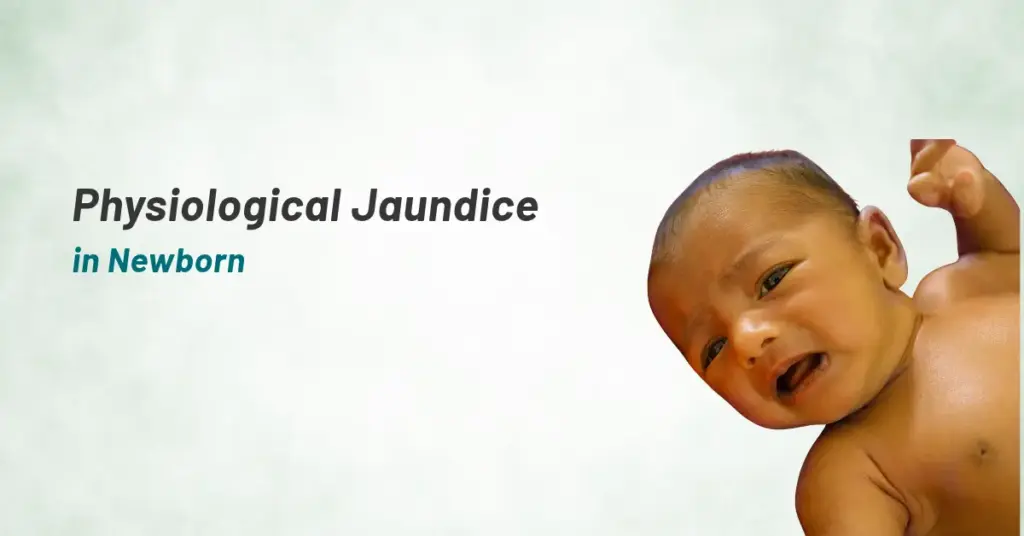
You bring your baby home, and by day three you notice a yellow tint on the face. Is this normal? Did something go wrong?
Take a deep breath. Physiological jaundice in newborn babies is very common, and in most cases it is harmless. It fades on its own as your baby’s body learns to clear a yellow substance called bilirubin. Still, it helps to know what is normal and when to call the doctor.
Key Facts About Newborn Jaundice
- Physiological jaundice usually starts after the first 24 hours, often on day 2 or 3, but only a doctor can confirm it is harmless.
- It peaks around day 3 to 5 and fades in about 1 to 2 weeks in most full term babies.
- Frequent feeding helps, but it does not replace bilirubin checks or treatment.
- Yellow skin in the first 24 hours, or a baby who is hard to wake or will not feed, needs medical help right away.
What is Physiological Jaundice in Newborns?
Jaundice means the skin and eyes look yellow. The color comes from bilirubin, which forms when old red blood cells break down. In adults, the liver clears it, and it leaves the body in stool.
Before birth, your body cleared bilirubin for your baby. After birth, your baby’s liver must do this alone and needs a few days to catch up. Until then, bilirubin builds up and shows on the skin. This short, natural phase is called physiological jaundice.
It is very common. About 6 in 10 full term babies, and even more premature babies, have some jaundice in the first week.
What Causes Jaundice in Newborns?
Many parents ask what causes jaundice in newborns and wonder if they did something wrong. You did not. Physiological jaundice is part of how babies adjust to life outside the womb. Three things work together:
- Newborns have extra red blood cells, and these break down quickly. That makes more bilirubin.
- The liver is young and slow in the first few days.
- Some bilirubin gets absorbed back into the blood from the gut instead of leaving in stool. This happens more when a baby drinks little milk in the early days.
Things that can make jaundice stronger
Jaundice can be deeper in babies born early, or those with birth bruising, poor feeding, a sibling who needed treatment, a mother with diabetes, or a blood group mismatch such as Rh or ABO.
Causes doctors check for
If jaundice starts early, rises fast, or stays too long, doctors look for other reasons. These include blood group mismatch, an inherited red blood cell problem called G6PD deficiency, infection, or a liver or bile duct problem.
Symptoms of Newborn Jaundice and a Simple Timeline
Jaundice shows on the face first, then moves to the chest, belly, arms, and legs. Check in natural daylight. Press a finger gently on the skin. If the spot looks yellow when you lift it, jaundice may be present. Yellow color is harder to see on darker skin, so do not rely on skin color alone. Check the whites of the eyes, the gums, and under the tongue, and ask for a bilirubin check.
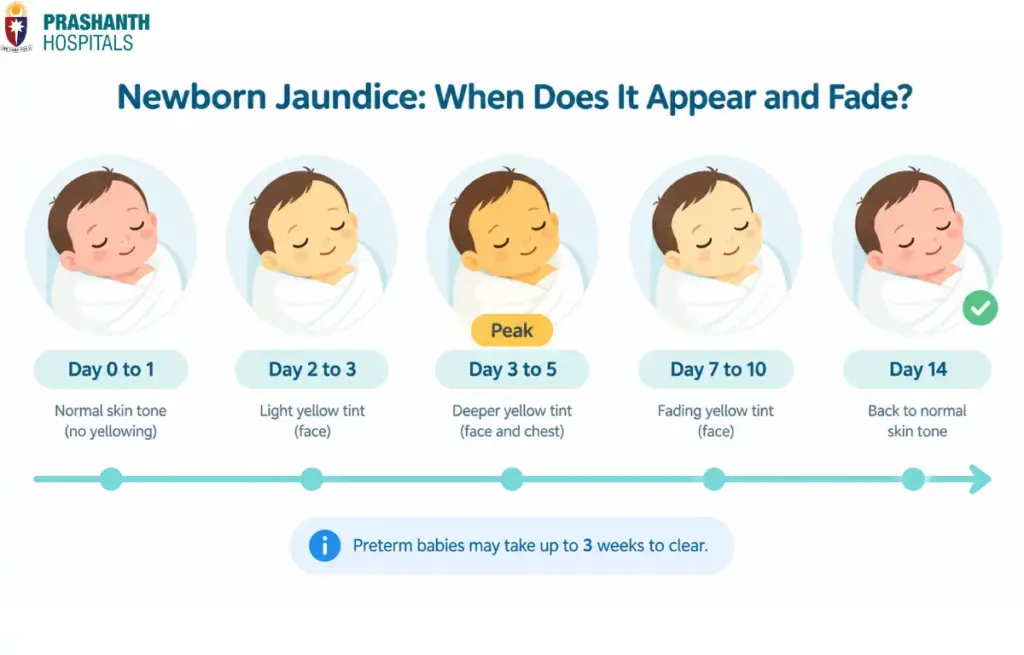
Here is what a healthy full term baby usually shows:
- Day 1: No visible yellow color. If yellow appears in the first 24 hours, get medical help right away.
- Day 2 to 3: A yellow tint starts on the face.
- Day 3 to 5: Jaundice is at its peak and may reach the chest and belly.
- Day 7 to 14: The color slowly fades.
What is the Difference Between Physiological and Pathological Jaundice?
Physiological jaundice is the normal kind. It usually starts after 24 hours, stays mild to moderate, and mostly shows on the face, chest, and belly. The baby feeds well and stays active. It fades within 1 to 2 weeks.
Pathological jaundice is not normal. It often starts in the first 24 hours or rises very fast. It may spread to the palms and soles. The baby may be sleepy, feed poorly, or have pale stools and dark urine. It can also last longer than 2 weeks.
A baby can have normal jaundice and another cause at the same time. So doctors look at timing, the bilirubin level, and how fast it is rising. Starting after 24 hours does not make jaundice harmless, and skin color alone cannot tell the two apart. Any baby who looks yellow should be checked.
Breastfeeding Jaundice and Breast Milk Jaundice
Breastfeeding jaundice shows up in the first week. It happens when a baby is not getting enough milk yet. More frequent feeding and help with latching usually fix it.
Breast milk jaundice appears after the first week and can last a month or longer. Substances in breast milk slow down how the liver handles bilirubin. It is usually harmless once a doctor has ruled out other causes. Keep breastfeeding unless your doctor says otherwise.
What is a Normal Bilirubin Level in Newborns?
Doctors measure bilirubin in two ways. A skin probe on the forehead gives a quick estimate. If the reading is high, a small heel prick blood test confirms the exact level.
There is no single normal bilirubin level in newborns the way there is for adults. Adults usually stay below about 1.2 mg/dL, but almost every newborn goes higher in the first week.
But doctors do not depend on one number. They plot your baby’s level on a chart that considers age in hours, weeks of pregnancy at birth, and risk factors. This tells the team whether to watch, repeat the test, or start treatment. So please do not compare your baby’s number with another baby’s. Ask for a bilirubin check before you leave the hospital and a follow up around day 3 to 5.
How to Treat Jaundice in Newborns
Most babies with physiological jaundice need no medical treatment. Their bodies clear it with time. Here is how to treat jaundice in newborns when care is needed.
Feed often
Frequent feeding is the most useful step. Breastfed babies should feed about 8 to 12 times a day in the first week. Feeding helps your baby pass stool, and stool is how bilirubin leaves the body. For formula fed babies, ask your doctor how much and how often. Feeding supports your baby, but it cannot replace bilirubin checks or medical treatment when your baby needs it.
Phototherapy
If bilirubin is high or rising, your doctor may suggest phototherapy. Your baby lies under a special blue light with eyes covered. The light changes bilirubin in the skin into a form the body can pass out. How long it takes depends on the bilirubin level and how your baby responds. It is safe and does not hurt. Rarely, when bilirubin is dangerously high, doctors replace some of the baby’s blood in a newborn intensive care unit.
Home remedies to avoid
- Sunlight: It is not a safe or reliable treatment.
- Water or glucose water: It does not reduce bilirubin. It fills the tummy, so your baby drinks less milk.
- Herbal drops or home mixtures: Avoid them unless your doctor approves.
When to See a Doctor
Get medical help immediately if:
- Yellow color appears in the first 24 hours of life
- Your baby is very sleepy, hard to wake, or refuses to feed
- Your baby has a high pitched cry, fever, a stiff or floppy body, or arches the head and neck backward
Call your baby’s doctor the same day if:
- Yellow color spreads to the arms, legs, palms, or soles
- Skin turns a deeper yellow or orange
- Your baby feeds poorly or has fewer wet diapers
- Stools are pale or clay colored, or urine is dark
- Jaundice lasts longer than 2 weeks
Newborn Care at Prashanth Hospitals, Chennai
If you are worried about your baby’s jaundice, a pediatrician can examine your baby, check the bilirubin level, and guide the next steps. You can request a pediatric consultation at Prashanth Hospitals, Chennai, for an assessment.