
A phone can calm a child in minutes. A cartoon can keep them occupied while dinner is being prepared, and a tablet can make a long journey easier. For parents, screens can be useful but the concern begins when a convenient habit gradually becomes a routine and starts replacing sleep, outdoor play, family conversations, schoolwork or simple unstructured play.
So, the important question is not simply “Is screen time bad for children?” It is “What is screen time replacing in my child’s day?” When thinking about screen time in children, paediatricians encourage parents to look at the child’s overall routine rather than focusing only on the number of hours spent on a device.
How Much Screen Time is Appropriate, by Age?
Screen-time needs and risks change significantly as children grow. The World Health Organization (WHO) and the American Academy of Pediatrics (AAP) offer general age-based guidance that parents can use as a starting reference, alongside their paediatrician’s advice:
| Age group | General guidance |
| Under 18 months | Avoid screen time other than video calling with family. |
| 18–24 months | If introduced, screens should involve high-quality content watched together with a caregiver. |
| 2–5 years | No more than 1 hour per day of high-quality, supervised content. |
| 6–12 years | No fixed hour limit, but screens should not displace sleep, physical activity, homework or family time; consistent daily limits are recommended. |
| Teenagers | Focus shifts from hours to content quality, context and impact on sleep, mood, schoolwork and relationships, given higher independent and social-media use. |
These figures are general benchmarks, not strict rules. A child’s temperament, content type and family context all matter, and parents should discuss individual concerns with their child’s doctor.
When Does Screen Time Become a Concern?
Screen use itself is not automatically harmful. Its impact depends on the child’s age, the content being viewed, when the device is being used and whether it interferes with essential parts of childhood.
| Area | What parents should look for |
| Sleep | Is screen use delaying bedtime or making it harder for the child to settle? |
| Physical activity | Is the child spending less time playing, exercising or being outdoors? |
| Learning | Are screens interfering with homework, reading or concentration? |
| Behaviour | Does the child become unusually upset or irritable when the device is removed? |
| Emotional wellbeing | Does the child seem more anxious, withdrawn or low in mood, particularly around social media use? |
| Relationships | Are screens replacing family conversations or face-to-face play? |
| Eyes and posture | Is the child experiencing eye strain, headaches or discomfort after prolonged use? |
The concern, therefore, is not the screen alone. It is what excessive or poorly managed screen use may be taking away from a child’s healthy physical, cognitive, social and emotional development.
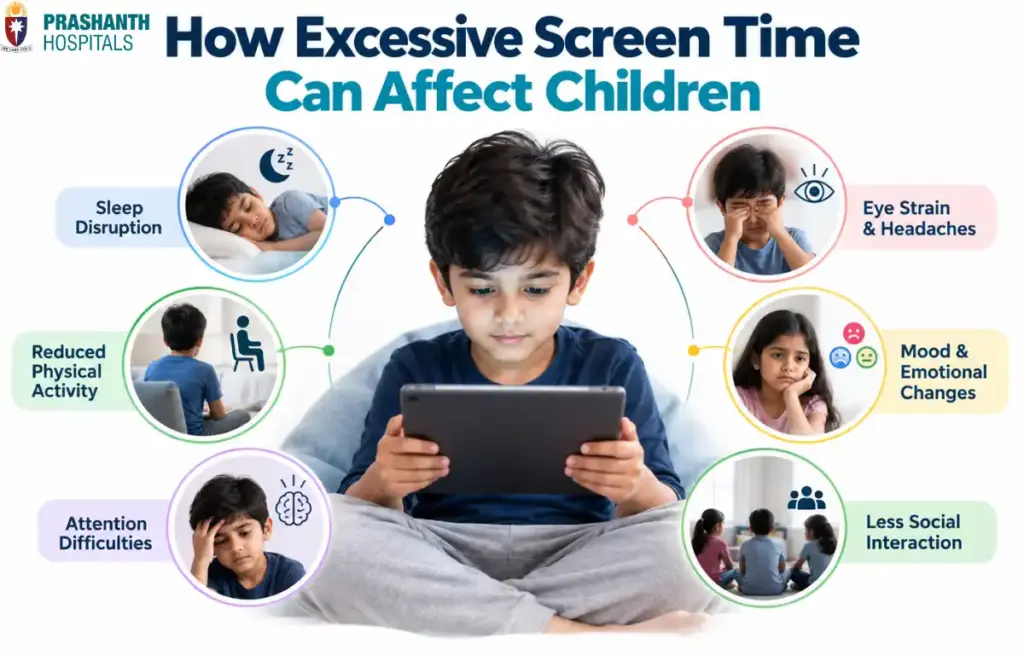
How Can Excessive Screen Use Affect a Child?
Sleep often shows the first signs
Screens used close to bedtime, particularly when the content is stimulating, can make it harder for some children to settle. A device can also turn “five more minutes” into a much later bedtime. For children, adequate sleep supports growth, learning, memory, mood and everyday functioning, so protecting sleep should remain a priority.
Physical activity can quietly decline
Childhood needs movement. Running, cycling, playing outdoors and participating in sports help children develop strength, coordination and physical confidence. The concern with prolonged screen use is therefore not simply that a child is sitting; it is whether screen time is gradually replacing opportunities to move and play.
Emotional wellbeing and mental health can be affected
For older children and teenagers in particular, heavy or unsupervised social-media use has been associated with increased anxiety, low mood, poor self-esteem and disrupted sleep, especially when it involves social comparison, cyberbullying or exposure to distressing content. Screen use is not the only factor behind these changes, but parents should stay attentive to shifts in mood, withdrawal from friends or family, or reluctance to go to school, and discuss these with a paediatrician if they persist.
Behaviour may change around devices
It is normal for a child to dislike stopping an activity they enjoy. However, repeated and intense reactions when a device is taken away deserve attention, particularly if screen use is interfering with meals, sleep, schoolwork or family routines.
Parents may notice:
- Frequent arguments about devices: If almost every attempt to switch off a screen becomes a major conflict, the family’s screen boundaries may need to be reconsidered.
- Less interest in other activities: If a child increasingly chooses screens over play, hobbies, reading or interaction with others, the balance may be shifting.
- Difficulty moving away from screens: Persistent irritability or distress when screen use ends can be a sign that children need clearer and more predictable boundaries.
These behaviours do not automatically mean a child has a problematic or unhealthy relationship with screens. They are signals to step back and look at the child’s overall routine.
What About Children’s Eyes?
Long periods of close-up screen use can contribute to digital eye strain, which may cause temporary symptoms such as tired or dry eyes, headaches or blurred vision. Time spent outdoors is separately associated with a lower risk of myopia (short-sightedness) in children, which is part of why regular outdoor time is encouraged alongside, not as a direct treatment for, screen-related eye strain.
Parents can encourage healthier habits by ensuring that children take regular visual breaks (for example, the 20-20-20 rule: every 20 minutes, look at something 20 feet away for 20 seconds), avoid holding phones or tablets extremely close to their faces and use screens in comfortable lighting. Persistent headaches, eye discomfort, blurred vision or difficulty seeing clearly should be discussed with an eye-care professional.
The Bigger Concern: What is the Screen Replacing?
Sometimes the impact of screen use is not immediately visible.
It may appear as less outdoor play, fewer family conversations, reduced imaginative play, later bedtimes or less time learning to manage boredom.
Children develop physically, cognitively, socially and emotionally through movement, conversation, play, observation and relationships. Screens can be part of childhood, but they should not become its default activity.
A healthy childhood needs more than entertainment.
Is There a Perfect Number of Screen-Time Hours?
Parents often want one number that tells them whether their child’s screen use is acceptable. In reality, age, developmental needs, content, context and the child’s overall routine all matter, alongside the general age-based benchmarks above.
Paediatricians encourage parents to consider screen use alongside four basic questions:
- Is the child sleeping well? Screen use should not regularly push bedtime later or interfere with adequate sleep.
- Is the child staying active? There should still be enough opportunity for outdoor play and age-appropriate physical activity.
- Is the child learning and developing normally? Screens should not consistently replace reading, schoolwork, creative activities or other developmental experiences.
- Is the child still connecting with people? Family conversations, face-to-face play and meaningful interaction remain important parts of childhood.
If these areas are consistently being pushed aside, the child’s screen routine deserves a closer look.
How Can Parents Build Healthier Screen Habits?
The answer does not have to be removing every device from the house. In most families, consistent and realistic boundaries work better than sudden restrictions.
- Create screen-free routines: Meals, family conversations and bedtime can become predictable times when devices are put away.
- Give advance notice: Letting a child know that screen time will end in a few minutes can make the transition easier than switching it off without warning.
- Replace rather than simply remove: Outdoor play, drawing, reading, puzzles, music and family activities give children something meaningful to move towards.
- Model the behaviour: Children notice adult habits. Putting phones away during meals and conversations makes screen boundaries easier for children to understand.
Parents do not need to create a perfect routine every day. The goal is a healthier overall rhythm.
When Should Parents Seek Professional Advice?
Most mild or occasional screen-time concerns can be addressed with practical changes at home, such as clearer routines and boundaries. However, parents should seek professional advice promptly when screen use is accompanied by persistent sleep problems, frequent headaches or visual complaints, significant behavioural or mood changes, declining school performance, or withdrawal from activities the child previously enjoyed, these may need clinical assessment rather than routine changes alone.
A doctor can help parents look at the wider picture and determine whether the concern is related to screen habits or whether another underlying issue needs attention.
A Healthier Screen Routine Does Not Have to Be Perfect
There will be busy evenings when a screen helps. There will be long journeys when a tablet makes things easier, and there will be days when parents simply need a few quiet minutes. That does not make someone a bad parent.
What matters is the overall pattern.
If a child is sleeping well, staying active, learning, playing, interacting with family and enjoying activities away from screens, there is a healthier balance. But when the device becomes the centre of the child’s day and everything else is gradually pushed aside, it is time to pause and reassess.
The goal is not a childhood without screens. It is a childhood in which screens have a place without taking the place of childhood itself.
At Prashanth Hospitals, parents can seek professional guidance if they are concerned about their child’s sleep, behaviour, vision, development, emotional wellbeing or overall health in relation to screen use.